File
Record file
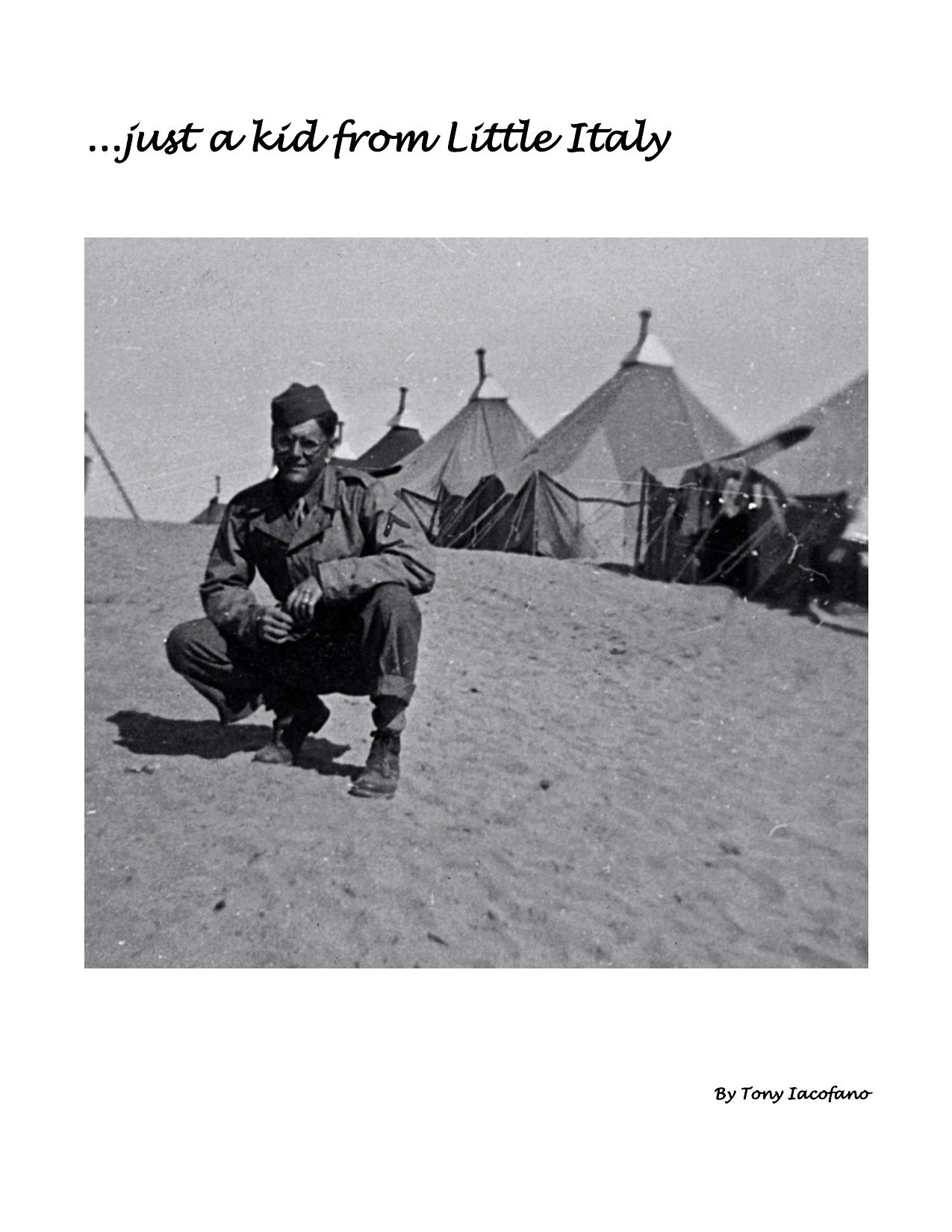
Ref: Arthur J. Iacofano WWII Narrative (Just a Kid from Little Italy)
Record
Family-authored 2021 narrative by Tony Iacofano about his father Arthur J. Iacofano's World War II Army service, reporting Arthur's draft, service, and discharge chronology, Company B and 175th Infantry Regiment service in the 29th Infantry Division, Morning Report NBC entries, and family photo context including a 1945 drawing of Mary Iacofano with baby John.
What it says
File
Reading notes
File
...just a kid from Little Italy
   By Tony Iacofano

2
LIFE UNFORSEEN        Wind shows itself by its effects.  Its touch might be cooling relief on a hot day or it may pull trees from the ground and hurl buildings like toys.  History is similar.  Like the wind, we don’t see it.  Its consequences, however, can alter the orientation of many lives in unforeseen ways.      Grandpa’s experiences during his younger years illustrate the unseen impact of history.  Pulled into an invisible vortex, he was pointed in directions he never could have envisioned.  His experience became similar to millions of young men of his generation.  Their lives upended, they played an unexpected role in a whirlwind called The Second World War.      At a time when Grandpa and the world began to stand up after almost being knocked out by the worldwide Depression, World War II delivered a second stunning blow.  This narrative relates what Grandpa and others faced while serving in the Army during the war.  Although his was a tiny piece of a greater puzzle, it helps to look at the whole puzzle to better understand the role he and many like him played.  The experiences faced by these men sent their lives in directions they never could have imagined.  Many would move on with their lives after the war, but many would battle the personal horrors in their minds for many years.         Grandpa never spoke of his time in the Army.  I can’t pretend to know why but I can relate my own experiences in spending a career working with the generation of World War II veterans.  Having had contact with thousands of men and some women who served during World War II, I can recall only a few times when veterans who experienced combat spoke of their war experiences.  I worked side by side for many years with a nurse who served in the Army during World War II.  We became close acquaintances and she became a mentor to me.  In all the time I knew her, she only mentioned once that she was a nurse in a field hospital just behind the front lines.  She never went into any detail or shared any experiences.      War not only exposes one to some of the most horrible sights and images, it also creates personal conflicts that do battle in one’s mind.  Many of that generation glimpsed fear as cowardice.  They never spoke of it.  Yet, survival is a natural instinct and any threat to one’s life creates a distress easily seen in the faces of soldiers marching into battle.  That distress is fear.  Telling their story may remind them of some terrible things.  Almost to a person, this is the reason they give for not speaking of their experiences.  They don’t want to feel that fear again.  Trying to make people understand re-ignites the horror of an ugly slice of life and personal conflicts they struggle to forget.         Because of my own service in the Army, I became curious of my father’s service.  Setting out to chronicle his experience, I searched for information and was able to find documentation   of one sort or another from the time he received his draft notice until he was discharged.

3
     Drafted on June 14, 1943, a month after he turned 21, Grandpa served just over two and a half years.  He was discharged honorably on January 13th, 1946, seven months after the War ended, at Indiantown Gap Military Reservation in Indiantown Gap, Pennsylvania.  The reason for discharge was “demobilization.”  Although the war in Europe officially ended on May 8, 1945, Grandpa’s unit, like other units, stayed to “mop up,” set up temporary government, provide services and gradually repatriate the three plus million German prisoners of war.  Besides his experiences, some of them traumatic, he came home with his Honorable Discharge papers, the Marksman Badge, Good Conduct Medal, the American Campaign Medal and the European-African-Mid Eastern Campaign Medal with one bronze star.  The bronze star indicated his service in a designated area of war.  We never saw those medals and they probably didn’t mean a lot to him.  Perhaps they served as reminders of things he didn’t want to remember.      Several sources proved valuable in piecing together this chronicle.  First, I contacted the National Archives in St. Louis, Missouri where all records of those serving in the military are stored.  Unfortunately, a fire on July 12, 1973 destroyed 80% of the records of U.S. military personnel discharged from November 1, 1912 to January 1, 1960.  Included in those records were Grandpa’s.  They did send me some records including his discharge papers which proved extremely valuable in providing information.  The discharge papers indicated that Grandpa was discharged from the 175th Infantry Regiment.  The unit one is discharged from doesn’t always mean a person served all of his time with that unit.  Second, I contacted the 29th Infantry Division Association which is located in the city of North East, Maryland at the far northeast end of Chesapeake Bay.  The 175th is one of three infantry regiments in the 29th.  They directed me to other sources of information that proved Grandpa did indeed serve all of his time with that unit.         An integral piece of information from the Association was the complete Morning Report of the 175th. Morning Reports are detailed “roll calls” that document a person’s presence in a unit on any given day.  The Morning Report I received covered a period of time from the D-Day landings on June 6, 1944 till the end of the War and beyond.  It has over 35,000 entries.  At its peak, Grandpa’s unit, the 175th, was comprised of 3,100 men.  The reason many entries exist is because they incorporated every replacement and everything that happened administratively or otherwise to every person in that unit with the date when it happened.  As a result, one person’s name might be entered multiple times.  What’s important is that the day a person enters that unit and the day he is dropped from the rolls of that unit is recorded and one can be assured that every day in between, that person stood in formation with that unit.  Other events like promotions or other administrative actions are denoted with the applicable date.  If a person is injured, missing or killed in action, the date is recorded.  Also, if a person goes to the hospital for any reason, the date is recorded as well as the date he returns or is dropped from the rolls due to injury or illness.

4
     Two books served as a third invaluable source of information that specifically detailed the time Grandpa was with the 29th in France, Belgium, Holland and the German Rhineland.  Written by Joseph Balkowski, the books add precise insight and detail to the actions and experiences of the different units and individual GIs.  They paint a picture of what it was like to be there and what the soldiers experienced on a day-to-day basis.  When Balkowski refers to Company B, 1st Battalion of the 175th Infantry Regiment, I know Grandpa was there because the Morning Report proves it.        The internet provided a fourth source of information.  Everything from accounts of battles, what the soldiers ate, recreation, diary entries to medical care could be found.           The final source of information was Grandma.  She recounted one event that had a profound and certainly traumatic effect on Grandpa.  Over many years, her details of that event never changed.  She also provided black and white photos of that time.  The photos lay in an old, bulk potato chip can in the corner of a closet and were rarely seen by us.  Along with the photos was the front section of the Cleveland Press with a huge front-page banner stating that the “War Is Over.”  It also related that Bob Feller would be re-joining the Cleveland Indians soon after discharge from the Navy.         One item in particular especially intrigued me. It lay almost unnoticed in the closet with the old photos.  Displayed in a rough, homemade wooden frame with a glass covering was a pencil drawing.  In the lower corner of that drawing was a wallet photo of Grandma holding baby John.  The pencil drawing was sketched from that photo by a German prisoner of war.  I looked on that drawing with a great deal of curiosity and was motivated to learn not only of the drawing, but of that period of time in my father’s life.  It represented a piece of history to me on the very basic, most personal level.  One could see the name of the artist and date he did the drawing, 1945. I remember once asking my father about the drawing.  Although I was in my early teens when I asked, it struck me that his expression changed to something I wasn’t used to seeing, and he spoke with hesitance, explaining that it was drawn by a German POW for a pack of cigarettes.  I clearly remember wanting to hear more, but that was all he said.  I don’t know why I didn’t press him for more information, but I think it was because the look on his face told me he didn’t want to talk about it.

5
 Pencil drawing of Grandma, Mary Iacofano, with baby John.  Sketched in the classic “Madonna and child” style, the drawing was copied from a small wallet photo by a German prisoner of war.  The artist’s name and date of 1945 are in lower right corner.    **********

6
     At different points in this narrative, I relate stories of Grandpa’s actions and his interactions with other GIs.  I have no way of knowing that these things really happened as I describe.  In the research I did, I read many accounts, diary entries and vignettes of different soldiers in Grandpa’s unit.  These were the fighting men at the grassroots.  I studied their movements and actions closely.  From common experiences that soldiers shared, I took the liberty of speculating on how Grandpa could have easily been substituted for any of the GIs in many of the common situations described.  He was one of them and present with them, experiencing the same things.      At one point, I convey the impression that Grandpa became good friends with another GI in his unit.  When a group of people are thrown together in a common situation, it’s easy to cultivate friendships.  Common threads like being close to the same age, the same gender and being somewhere you don’t really want to be while working toward a common goal weave a bond that draws people together.  When that common goal includes the possibility of danger, injury or death, friendships become almost necessary.  That’s the common mentality of friends watching each other’s back.  These guys don’t go home to their families at the end of the day. Their temporary families are the guys in their unit and they’re together twenty-four hours a day.  Friendships develop easily and readily in these kinds of situations.      I name the person who I though became Grandpa’s close friend.  Like Grandpa, he was a draftee and probably close to the same age.  From the geographical region of New York, he entered onto duty with the 175th in France on the same day Grandpa did.  Assigned to the same unit, Company B, their names fell close to each other in the alphabet.  The Army is notorious for alphabetical order.  That is, among many other things when personnel are involved, they assign soldiers to units from an alphabetical list.  For example, it would be quite common to call out to a group that “everybody with their last names starting with G up to and including everyone with their last names starting with L will be replacements for Company B.”  Replacements received training from the personnel of whatever division they would be joining at the Replacement Depot.  In Grandpa’s case, he received training by the cadre of the 175th with company designation already assigned.  Names close together in the alphabet might very well mean that they could have been in the same platoon, which means they would spend much of their time in each other’s presence day and night.        A company during World War II consisted of three to six platoons.  A platoon is a 41-man unit.  Members of the same platoon would likely be training, living and fighting in a small, unified group.  Of all the men in his company, I narrowed the search to two men who could fit the description of being his close friend.  Three things influenced my search:  the alphabetical closeness of the names, the date they entered onto duty and what occurred on the battlefield.  The names of both men started with “G,” which would be closer to Grandpa’s last name starting with “I,” meaning they could have been assigned to the same platoon.  They entered onto duty close to the same time and the same thing happened to both in combat in which they participated together.

7
     One of the two men was a Hispanic draftee from the southwest and the other was a draftee from the area of New York.  Grandpa had relatives in New York City.  He would probably gravitate to the man from the New York area because of the common link of relatives.  I went through the Morning Report of approximately 35,000 names several times to find these common links, so, although it’s speculation on my part, it does have some convincing evidence backing up the speculation.  Below is a sample of the Morning Report with the names of the two individuals.  Pvt. Gallego entered onto duty one day earlier than Grandpa.  But he was one of the men from Grandpa’s company killed in a particular battle.  Pvt. Goldstein entered onto duty that same day as Grandpa and was also killed in the same battle.    Section of Morning Report of 175th Infantry Regiment, 29th Infantry Division:   Goldstein Edward  32898508 Pvt B175 27-Sep-44 fr repl depot to dy 20 Sept 745 175     B Goldstein Edward  32898508 Pvt B175 21-Nov-44 fr dy to MIA 16 Nov 745 175     B Goldstein Edward  32898508 Pvt B175 25-Nov-44 fr MIA to KIA 16 Nov 745 175     B Gallego Gabriel L 39577685 Pvt B175 25-Sep-44 fr repl depot to dy 19 Sept 745 175     B Gallego Gabriel L 39577685 Pvt B175 21-Nov-44 fr dy to MIA 17 Nov 745 175     B Gallego Gabriel L 39577685 Pvt B175 25-Nov-44 fr MIA to KIA 16 Nov 745 175     B  MIA:  Missing in Action.   KIA:   Killed in Action.  It’s common for someone KIA to be first listed as MIA since it might take some time to find and identify the dead soldier’s unit and to get the word to that soldier’s unit from the medical treatment area.  The date noted on each line is merely the date that the unit’s clerk gets the information.       Grandma related an incident that likely traumatized Grandpa.  Over the years, her description of the account never changed.  She said that Grandpa shared a foxhole with his friend.  An artillery or mortar shell landed nearby and shrapnel hit Grandpa’s friend killing him.  Shrapnel, mangled pieces of steel can rip through a person’s body with great velocity, almost like a bullet.  He fell dead right next to Grandpa.  Six days later when there was a break from combat, Grandpa went on sick call and was subsequently taken off the rolls of the unit. He was eventually assigned a non-combat role as a guard in a POW camp.      Shown below is a section of the Morning Report of the 175th Infantry Regiment which covers the time from the D-Day Invasion on June 6, 1944 till the end of World War II.  This sample shows 11 out of nearly 35,000 entries.  Grandpa’s name, complete with a misspelling, is shown multiple times to denote every administrative action from entrance onto duty, to the day he was dropped from the rolls of the 175th and everything that happened in between.  This is clear proof that Grandpa was with Company B,175th Infantry Regiment from September 20th, 1944 until November 24th, 1944.  The days he was not present and the reasons are noted in the report.

8
            Hyytianen
    Ilmari
    E
    31069764
    T 5
    Sv175
    23-Jun-44
    fr hosp LIA to dropped fr rolls 20 June                                          --- Hyytianen   Ilmari E 31069764 T 5 Sv175 8-Jun-44 LIA, sent to Co D, 1st Med Bn                                                       --- Iacofajo Arthur J 35066128 Pvt B175 28-Sep-44 fr repl depot to dy 20 Sept                                                             745 Iacofano Arthur J 35066128 Pvt B175 2-Nov-44 fr dy to hosp NBC 1 Nov                                                               745 Iacofano Arthur J 35066128 Pvt B175 23-Nov-44 fr dy to hosp NBC  22 Nov                                                            745 Iacofano Arthur J 35066128 Pvt B175 24-Nov-44 fr hosp NBC to dropped fr rolls                                                      745 Iacofano Arthur J 35066128 Pvt B175 25-Nov-44 fr hosp NBC to dy 1 Nov                                                               745 Iadeluca Robert B 12085828 1st Sgt D175 6-Sep-44 fr repl depot to dy 2 Sept                                                               585 Iadeluca Robert B 12085828 1st Sgt F175 1-Oct-44 reduced to Pvt 22 Sept                                                                 585 Iadeluca Robert B 12085828 Pvt F175 1-Oct-44 promoted to Sgt 22 Sept                                                               ---        The abbreviations in this section of MR, Morning Report are as follows.  LIA:  Lightly Injured in Action;  dy: duty;  repl depot: replacement depot;  NBC: Non-Battle Casualty.  Each entry, in order, lists the last name, first name, middle initial, serial number, rank, unit, date of entry and action or reason for the entry.  The brown highlight color is mine.  The date transcribed on each line is the date the clerk made the entry.         A soldier’s 8-digit serial number provides some information about that person.  The first number tells whether he was drafted, enlisted or a member of the National Guard.  The number “3” tells you he is a draftee; “2,” a National Guardsman and “1,” an enlistee.  The second number tells you the geographical location of his home of record.  Grandpa’s first two digits are “35.”  This shows that he was a draftee from a region that included Ohio.  The soldier above Grandpa’s name was a draftee from New England.  The soldier below was an enlistee, that is, he joined voluntarily, from Delaware, New Jersey or New York.       The right part of the Morning Report is cut off in this narrative but not in the original.  It shows the persons Military Occupational Specialty, abbreviated MOS.  Although trained as a mortar crewman, MOS 844, Grandpa’s MOS is listed as 745 on this report.  That’s the MOS number for “Infantryman.”  It’s a common occurrence in the Army for one’s commander to say, “We don’t need mortar crewman, we need infantrymen!  You are now an infantryman!  You’re fully capable of carrying a rifle and pulling a trigger!”    THE STORM AFTER THE STORM       A song of hope in 1939 would go on to become one of the most popular movie songs of all time.  Performed by Judy Garland, the lyrics resonated with Depression-era audiences all over

9
the world.  In the movie “The Wizard of Oz,” Dorothy Gale sang wistfully of somewhere better than the inhospitable and dreary landscape where she found herself.  Played on radios all over the world, people saw The Great Depression finally fading away.  Better times awaited “somewhere over the rainbow.”      Or did they?         The Great Depression didn’t end in the same dramatic way it began with the alarming crash of the Stock Market.  It faded away towards the end of the 1930s.  Just seven years old when it started, Grandma and Grandpa were seventeen when it ended.  The direction of their young lives was forged by economic hard times that hobbled the country and world.   Although things were still tenuous, better times on the other side of “the rainbow,” would become elusive as the 30s faded into the 1940s.        Grandpa’s father died in the early 1930s when Grandpa was just nine years old and the Depression was at its worse.  Living through the hard times, Grandma and Grandpa saw their families struggle to put food on the table.  Both dropped out of high school to assist in that effort.  Back then, they learned that a strong work ethic, something they carried through life, was more important than education.  Work put food on the table right now when it was needed.  Education could wait.  They had to be thrilled when they saw the employment situation improving and the prospects of getting a steady job right in front of them.      They also heard about a war that began to spread across Europe and Asia like a blot of ink spreading over a pool of water.  Things were different back then.  Television, in its infancy, wasn’t a practical device for most homes.  TVs cost too much and programming wasn’t very established.  This meant that cable news channels with 24-hour coverage wasn’t even an idea.  Electronic devices to carry in your pockets and look at headlines happening in real time would be thought of as science fiction.  News came from radios and newspapers.  Radios, found mainly in a person’s residence, were bulky and had to be plugged in.  The chief electronic device of the times, they were almost two decades away from being standard equipment in cars because they cost too much.  A new Emerson radio advertised for the bedroom cost just under $20.  Back in 1940, that was equivalent to $280 in today’s money.  The three main radio networks, NBC, CBS and Mutual Broadcasting, broadcast the news only three times a day for ten minutes at 7 A.M., 12 noon and 6 P.M.  Radio networks had the ability to break into local programming to report on an event soon after it happened.  This gave birth to the concept of “breaking news” coverage which gained popularity during the radio years.  Other sources of news were the three daily newspapers in Cleveland:  The Press, The News and The Plain Dealer.  People became alarmed and concerned when they learned that Germany attacked England by air in 1940.  But many in the U.S. had a somewhat isolationist policy and started to see this war as a vehicle to ramp up a recovering economy.

10
**********       Grandpa was just a guy from Little Italy looking to start his new life with Grandma.  They got married on September 1st, 1941, Labor Day.  Grandpa was twenty-two years old and Grandma was two months shy of twenty-two.  She had a new job in the laundry of University Hospitals, right down the street and around the corner from her Random Rd. home.  Grandpa had finished training at the Cleveland Barber College and got his Barber’s License.  Their world was Little Italy and as far as they could walk from it, since not too many young or even older people had cars.  The idea of two cars in a family was unheard of.      Rockefeller Park was a favorite place for the older kids who lived in Little Italy.  Grandma and Grandpa, with their friends would venture from home and pass through the campus of Western Reserve University.  From there they would cross E. 105th St. and head down Liberty Blvd., now named Martin Luther King Jr. Drive.  Grandma always recalled that you had to go under seven of the arched red brick bridges in the park before you would reach Lake Erie.  The settlement of Little Italy was created when John D. Rockefeller brought Italian stone masons and laborers from Italy to build those bridges and do all the stone and brickwork for the park that would bear his name.      They lived right around the corner from a movie theater, Mayfield Theater on Mayfield Rd.  Perhaps as a date night after they got married, they went to see one of the most popular actors of the time, Humphrey Bogart, in the newly released movie, “The Maltese Falcon.”  Feature films were always preceded by a cartoon.  “Tom and Jerry” cartoons were a favorite at the time.  Before the cartoon, the audience would be warmed up with a newsreel produced twice a week by Universal Studios and shown in just about every movie theater in the country.  This would have been a film report of current events in the country or world.  Newsreels certainly reported on the war in Europe and Asia as well as the destruction being visited upon England by Germany.

11

     TOP LEFT:  Wedding Day:  Mary, Arthur and Mary’s mother, Christina Ricciardi on September 1st, 1941, Labor Day.  Behind Christina’s left shoulder is Mary’s father, Domenic.  TOP RIGHT:  Arthur Joseph Iacofano at age 19.  BOTTOM LEFT:  Just a guy from Little Italy.  BOTTOM RIGHT:  Mary Iacofano at age 19.

12
     At this point in their young lives, Grandma and Grandpa were at the juxtaposition of two of the biggest historical events of the 20th Century.  They had just experienced the economic ravages of The Great Depression.  Soon, their lives would be touched by the depredations of a faraway war.  On December 7th, 1941, just two months after they got married, the Japanese attacked Pearl Harbor drawing the United States into World War II.  Five days later on December 12th, after Germany declared war on the U.S., the U.S. declared war on Germany as well.  Earlier that same summer, President Franklin Roosevelt’s extended the draft from twelve to thirty months for males between the ages of eighteen and thirty-seven.  That action by the President had a profound effect on their lives.
 Like most major newspapers in the country, The Cleveland Press cost four cents.  This is how people got their news in any detail.  Radio broadcasts on the three major radio networks summarized the news in three daily ten minute broadcasts.  These were the headlines on every newspaper in the country on Monday, December 8th, 1941, one day after the Pearl Harbor attack.        Grandpa wouldn’t be drafted for another eighteen months.  As a result, they spent the next year and a half agonizing with the specter of the draft threatening their young lives.  Anyone over the age of eighteen had to plan their life around the possibility of being called into military service.  Imagine having a medical test, the results of which will determine if you live or die.  Then imagine the doctor telling you that if you don’t get a letter from me, you’re alright.  He

13
gives no indication of when he might send that letter.  In the same way, a young man waits for that notice from the Selective Service, knowing that if it doesn’t come, he’s home free. The longer one waits, the more one hopes and begins to think that maybe he won’t get drafted.  Then, when you think you’re home free, eighteen months later, you get the letter.  That’s what it’s like to live with the draft hanging over your head.  It’s a letter that literally upends your life.  But wondering and waiting to see if you’re going to get drafted upends your emotions long before you get any letter.      In 1942, the war wasn’t going well for the Allies.  Grandma and Grandpa worked in a climate of an improving economy, but the looming draft hung over their heads.  At the end of the year, the annual gathering in Times Square to usher in a new year was like no other and reflected the mood of the country.  Revelry, happiness and optimism that always pervaded the event disappeared.  The bright lights of Times Square were dimmed and there was no ball drop to symbolize the end of the old and beginning of the new.  Instead, a moment of silence was observed.  Authorities cited concern that bright lights could guide German bombers to the center of the country’s biggest city.  A newspaper report the next day said that “400,000 people milled around in the dim light like zombies roaming aimlessly.”           Scanning the obituaries in the Plain Dealer every day, Grandma and Grandpa often saw familiar names of guys they grew up with from the neighborhood killed in the war.  Meanwhile, the mailman brought bad news on June 14th, 1943.  It was the draft notice he hoped wouldn’t come; the unwanted ticket that would take him from his home for a long time.  A popular song playing on the radio was a tune that echoed the feelings young men who were told by their government to report for duty.  It was “Stormy Weather (Keeps Rainin’ All the Time)” by Lena Horne.   Grandpa went into the Army on June 28, 1943 and spent just over a year training in southwest Texas at Ft. Bliss in El Paso.  In late July of 1944, he came home on leave with orders that would send him to France via Glasgow, Scotland.

14
 Art & Mary in front of Art’s home on Random Rd. in Little Italy.  It’s July 1944 before Art ships to Europe   **********       On August 15th,1944, Grandpa boarded a troop train in Cleveland headed for New York City.  Meanwhile, nearly 4,300 miles away, the Allies invaded southern France near Cannes in what was called Operation Anvil.  Their first objective was to liberate Paris and to be the southern “jaw” of a pincer movement against the Germans in France.  The northern part of the “jaw” would be the Allies who came ashore during D-Day two months earlier.  Their goal would be to crush the Germans in their “jaw” and push them out of France and back into Germany.  By the time Grandpa arrived in Glasgow eight days later, the capitol of France, Paris, had been liberated.  Despite this, the Germans would still have pockets of resistance in France.        As the train pulled out of the Cleveland Union Terminal under the Terminal Tower, Grandpa felt wistful at the prospect of being gone again for a long time.  Noise and cigarette smoke quickly filled the train car as GIs yelled out the window to their loved ones and

15
watched them get smaller and smaller on the platform while the train gained speed heading east.  Peering out the window, he got a glimpse of Lake Erie with the sun’s sparkling reflection on the surface.  A range of emotions likely filled the minds of many young men on board.  They ranged from a strong desire not to be where they were right now to visions of being war heroes and marching in parades.  Grandpa felt a twinge of sadness laced with uncertainty as he reached into his shirt pocket.  Pulling out a pack of cigarettes, a rosary fell into his lap.  He put the necklace of black beads with a cross hanging from it in his pants pocket and thought of his mother who gave it to him.  He lit a cigarette and stared out the window.  It was sunny, windy and hot in Cleveland with a temperature in the nineties.       Grandpa traveled across the Atlantic on the French luxury liner, Ile de France. The luxurious ship had been converted to a troop ship and left New York on August 17th.  It arrived in Glasgow, Scotland eight days later on August 25, 1944.  Travelling on the ship were replacements for the 175th Infantry Regiment, Grandpa being one of them.  It had to be a little unsettling for him and others to be on a ship loaded with replacements for a combat unit.  Why do they need so many replacements?            Crowded and noisy, the troop ship showed few signs of its once extravagant trappings.  The French luxury liner had been on its way to New York from France with some of the richest French and European citizens aboard when the Nazis occupied France.  Owners of the ship decided to keep the liner in New York rather than return to France where the Nazis would, no doubt, confiscate it.  Instead, the owners agreed to let the ship be used in the Allied war effort.        Many of the young men on board had probably never been very far from home, let alone on a ship crossing an ocean.  Soldiers passed their time on the voyage playing cards or dice in penny-ante gambling.  Some read and others talked with their fellow voyagers as they enjoyed the fresh salt air.  Many wondered what was awaiting them at the end of their voyage.  Red Cross volunteers distributed blank V-Mail forms and encouraged soldiers to write home.  Made of lightweight paper, the 7 x 9-inch government produced forms could be folded and sealed without an envelope.  Finished V-Mail letters would be sent to censors where they were read, photographed and placed on microfilm before being sent on to the soldier’s addressee.  Normal mail from 150,000 people would fill thirty-seven standard mail bags and weigh 2,500 pounds.  The same number of V-Mail letters would require only one mail bag and weigh just forty-five pounds.  The weight and bulk of the mail was dramatically reduced by using V-Mail and didn’t impede the transport of war materials to the front.

16
 V-Mail, short for “Victory Mail,” went both ways.  Soldiers could write their letter and send the one page form to their loved ones back to the States.  People in the states could write back to the soldiers also using V-Mail.  It was a highly efficient and a free way for soldiers and their loved ones to communicate.    Mail was the only way to communicate with loved ones overseas and back home.  Soldiers looked forward to “mail call” as much as they looked forward to a good meal or a good night’s sleep, both of which were almost non-existent on the front.  Trans-Atlantic telephone service did not exist.  Mail was the only way to communicate with loved ones and it could take two weeks or more for a letter to reach its destination.         Grandpa walked around the decks and met many guys from all around the country.  He noticed many of the soldiers with the same shoulder patch as his.  It was a yin-yang symbol, a circle with two swirling halves of contrasting colors, blue and grey.  The blue and grey colors are symbolic of the unit’s participation in the Confederacy during the Civil War. This was the shoulder patch of the 29th Infantry Division.  The unit within the 29th to which Grandpa was assigned was the 175th Infantry Regiment.  He saw many passengers with the same insignia.  The unit had a long history, starting out in 1776, as the Maryland Militia under the command of George Washington.  They later became the 5th Maryland Militia and fought for the Confederacy.  They got the nickname, “The Dandy Fifth” in 1867.  In 1941, as a Maryland National Guard unit, they were activated as the 175th and placed in the newly formed 29th Infantry Division with other National Guard units from Virginia, Kentucky and Washington D.C.  Grandpa, and many others, probably had no clue of the unit’s history and it didn’t really matter to them.

17
       Art in “dress greens.”  This is one of the uniforms he might have worn when he travelled across the Atlantic on the Ile de France.  On the left upper arm at his shoulder would have been a 29th Infantry Division patch, shown to the right of his photo.  The nickname of the 29th is “The Blue and Gray” and their motto is “Let’s Go!!”  Grandpa also would have had his private stripes on each sleeve.          This was the first time in Grandpa’s life that he ventured any significant distance from Little Italy.  Any feelings of homesickness didn’t have a chance to wander to the front of his mind.  Hundreds of young men in the exact same situation as Grandpa drowned out those feelings, at least for the time being.  One can derive a sense of comfort in being amongst a mass of people going through the exact same thing as you.       On the same day he arrived in Glasgow, Paris, the capitol of France, was liberated by the Allies. Led by French General Charles DeGaulle, Allies marched into the French city after four years of Nazi control.  Wildly cheering crowds of Parisians lined the streets and leaned from every window waving French and American flags.  This was the end result of Operation Anvil which started 10 days earlier as Grandpa was leaving on the train from Cleveland to New York.        Nearly a month passed from the time Grandpa arrived in Scotland on August 25th, 1944 till he entered onto duty with the 29th Division.  I don’t know how much time he spent in Scotland.  The Army had a training center there at one time, but by the time Grandpa arrived, it had closed down.  The extra training function moved to the Replacement Depot in France.  Because of this, he and all the replacements had no reason to spend time in England.  They most likely travelled south down the length of England via train and across the English Channel to France via troop transport.  He might have entered France through the Port of Cherbourg, which had been cleared of all the rubble and mines left by the Germans and was

18
now open for business.  Or he entered via the temporary docks set up as part of the D-Day invasion in Normandy.  His eventual destination was the Army’s 16th Replacement Depot in Compiegne, France, fifty-five miles northeast of Paris.       New replacements participated in training that taught them what to expect at the front.  The “Repple-Depple,” as the troops called The Replacement Depot, also familiarized the replacements with the idiosyncrasies of the unit they were about to join.  Training cadre from each division trained replacements earmarked for their division.  After a few weeks of training, the centrally located Depot could send replacements to the different divisions at the front fairly efficiently.       The unit Grandpa was slated to join had been engaged in some of the fiercest fighting in Europe.  Being a unit of National Guardsman, the 29th Infantry Division had been activated in 1941.  National Guardsmen and their officers are looked down upon by Regular Army personnel.  They are derisively referred to as “weekend warriors” since any military experience they get is on one weekend a month and two weeks in the summer.  They had no previous combat experience.  Once placed in combat, it didn’t take long for this division to prove themselves to their Regular Army critics.  Their first combat experience was the D-Day invasion.  Their landing point was Omaha Beach.  This was truly an initiation in fire since many of the ten-thousand casualties of all the combined units occurred on Omaha and Utah Beaches.  The 29th suffered three-thousand casualties on D-Day with over a thousand killed.  The casualties didn’t stop them.  It’s important to understand that a “casualty” refers to a person either killed or injured in war.          From the Normandy beachhead, the 29th moved inland where they fought bitterly in the hedgerows of the French countryside.  Their new objective was the transportation center of St. Lo.  Emerging victorious on July 18th, they pushed southeast to Vire, France, where they helped capture the city by August 6th.  Next, they advanced to the French west coast where they battled the Germans for the port of Brest, France, a major German submarine base on the beautiful and scenic peninsula in Brittany.  By the 25th of September, they helped secure the surrender of German troops from Brest and earned a well-deserved and promised rest of two weeks.  Brittany was an ideal location for a peaceful, restful break from war.  Meanwhile, thousands of German POWs from Brest and all over France were being transported to hastily set up POW camps, barbed wire enclosures with few facilities.         Unfortunately, any break from action would have to wait.  Just as the 29th started their promised two-week rest, General Omar Bradley ordered them to fill a critical gap on the Allied front lines nearly 600 miles to the east in the German Rhineland.  That’s where Grandpa and other replacements would meet up with and join the 29th.

19
     Grandpa was officially picked up on the rolls of the 29th Division on September 20th, 1944.  They call it his EOD date, entrance onto duty.  He knew he would be a member of the 175th Infantry Regiment, and by the time he EODed, he knew he’d be in the 1st Battalion, Company B.  The 29th didn’t arrive in their staging area just west of the German border until the 30th of September.  That’s probably when Grandpa travelled from the Depot to join his unit.        For clarity, an infantry division of 14,100 men, the 29th had three infantry regiments of 3,100 men each.  Each regiment had three battalions of about 1,000 members.  Each battalion had four to six companies of 120 to 200 men.  Each company had four to six platoons of 41 men.  Each platoon had four squads  of about 10 men and each squad had two teams.  Infantry divisions had units of medical, police, armor, artillery, engineers and whatever other support units they might need to be self-sufficient on the field.        Back in August while Grandpa was crossing the Atlantic, he, and probably others, had wondered why so many replacements for one unit were needed.  The answer lay in the activities of the 29th over the last four months, the time between D-Day, June 6th till September 25th, 1944.  The 14,300 man 29th Infantry Division suffered 15,000 casualties with 3,000 deaths.  This rag-tag division of National Guardsmen and draftees had been well initiated in their role as a combat unit.  **********        Grandpa and a truckload of replacements travelled 167 miles northeast from the Replacement Depot in France to Antwerp, Belgium on their way to join their new unit.  A photo shows him crouching on a pile of rubble.  Less than a month earlier, it was a building.       As these young men travelled to the front, nothing prepared them for the total devastation they observed.  None had ever seen anything like it.  During their all day, 250-mile journey to the front line via Antwerp on the back of a two-and-a-half-ton Army truck, Grandpa and the others saw the massive destruction caused by war.  Roads heavily pocked with bomb craters impeded travel.  Buildings and houses lay in ruins along the way.  It was Sunday, October 1st, 1944 and the truck caravan had to slow for a funeral procession of civilians carrying four caskets to a small country graveyard.  France had over 1,500 of its cities and towns bombed and destroyed.  432,000 houses had been completely destroyed and another 890,000 houses were partially destroyed.  Over 60,000 civilian men, women and children had been killed.  Like many other soldiers, many of them in their late teens and early twenties, observing first hand this devastation had a sobering impact on their conception of war.  Nothing they heard on the radio, read in the newspapers or saw in movie theater newsreels did justice to the devastation and suffering they were seeing firsthand.  Grandpa, nor any of

20
the guys travelling in the back of the truck, saw the big picture and what it all meant.  The merely witnessed the results at the grassroots.          They stopped in Antwerp for a break.  This major port city, had been heavily shelled by the Allies and taken from the enemy on September 4th, 1944.  Hitler recognized the importance Antwerp’s port and the Germans fought stubbornly to keep the entire area in their hands.  The British and Canadian troops who took Antwerp suffered nearly 13,000 casualties.  A good portion of the city was destroyed by artillery fire.  All this fighting and destruction had occurred less than a month earlier.         The future of the Allied war effort depended on the capture of Antwerp.  It also depended on when the British could clear German resistance from the 50-mile Scheldt Estuary leading to Antwerp from the North Sea.  Added to that, all mines would have to be cleared from the waterway itself.  The Allies needed this key port city if they wanted to supply a major military push into Germany, which would require a massive amount of supplies.  Overland routes from France with the bombed-out roads and a railroad in disrepair would not be adequate.  French ports didn’t have the capacity to deal with the immense amount of war material.  They needed a major port close to the front and Antwerp, one of the largest ports in Europe, filled that requirement.
 Antwerp, Belgium:  Grandpa, barely visible, is crouching on a pile of rubble just to the left of a larger pile of rubble.  On the far right is a sign that reads “DE ANTWERPEN.”  It was probably late September, early October, 1944.  He is being transported to the new staging area of the 29th Infantry Division, 80 miles to the east and just across border from Germany in the southern panhandle of Netherlands.

21
     From Antwerp, Grandpa and his fellow replacements would travel another eighty miles southeast to the slightly rolling pastureland in the south of Netherlands.  The front lines were just another twelve miles to the east across the German border.  Gray skies with periods of heavy rains dominated the weather, which was typical autumn weather in this corner of the world.  Hovering in the high fifties, the dampness in the air made it feel cold and uncomfortable.  The sun stayed hidden behind the heavy carpet of clouds while the constant rain guaranteed a landscape of mud.             The pastureland just outside of Valkenburg, Netherlands lay just west across the border from Germany.  The closest large city was Aachen, Germany less than 30 miles southeast.  The German city of 165,000 was considered the gateway to the Rhineland and the site of a major battle as the Allies tried to capture this key garrison in the German defenses.  Allied aircraft was grounded in the foul weather and couldn’t provide critical coverage to attacking troops.  This prolonged the battle.      The two-and-a-half-ton Army truck slowed to a stop.  Nicknamed “deuce and a halfs,” Grandpa and the other troops jumped off the back.  Considered “workhorses” of Army vehicles, M-35s as they were officially called, could carry twenty-four soldiers in the back.  On this day, twenty-three soldiers made the trip.  An olive drab canvas cover kept passengers out of the rain.  That was the only comfort measure, however.  Wooden bench seats and stiff suspension made it a highly uncomfortable ride.  Despite the rain and muddy puddles, it finally felt good to stretch and move around.           This was the staging and bivouac area of the newly arrived 29th.  The surrounding pastureland didn’t look much different from some of the farmland in Ohio.  Dressed in full battle gear, the new replacements wore their steel helmets, called steel pots, over their hard fabric helmet liner.  They all wore rain ponchos and slung their M-1 rifles over their shoulders.  Anxiety and uncertainty kept any smile off their faces.  Looking around, they wondered when and where they’d be able to get out of the rain and chill. All they saw was row after row of low slung, 2 man sleeping tents amongst the deep puddles and mud.  Larger tents lined a makeshift road of muddy tire tracks right in front of the new arrivals.  All of these tents had been hastily pitched over the last few days.  They could see some large, open canopies with soldiers sitting casually under them eating from their mess kits, smoking, playing cards, gabbing with each other or just reclining and resting.  Well, that answered the question they all had at the front of their mind, “where do we go to get out of the rain and chill?”        Directing the men into formation, a portly master-sergeant with a low, bellowing voice, called them to attention.  They all watched as someone placed a box in the mud directly in front of and in the middle of the formation.  A Sergeant-Major splashed through the water and mud and stepped onto the box.  “At ease, men,” he echoed then after a brief welcome related

22
some administrative details.  When he was finished, he directed everyone’s attention to several men standing off to the side.  They were the 1st Sergeants of companies of the 175th that would be getting replacements today.  The Sergeant-Major called the men back to attention, dismissed them and directed the replacements to find the 1st Sergeant of the company to which they were assigned.  Grandpa and several others found the 1st Sergeant calling for Company B replacements and followed him.  The 1st Sergeant led them to their company area, pointed a few things out and left them with other members of Company B who were sitting under a large canopy.  Other than a few of the guys under the canopy nodding and saying a cursory hello, everyone else continued doing what they were doing and didn’t pay much attention to the new guys.  Two of the new replacements and Grandpa had travelled together from the Replacement Depot.  They had been hanging around with each other during training at the Depot and had already become quick friends.  They were cousins, Ed and Harold Goldstein from New York City.   Like Grandpa, both were draftees and privates who had received their draft notices on the same day.      Harsh conditions were made worse by the total absence of a warm and cordial welcome from members of their new unit.  This was a common occurrence in the Army.  Close friendships would develop among men who trained together in a unit.  Now, a bunch of new and very green troops were being thrown in with troops who had seen some of the toughest fighting in World War II.  Many of the troops hanging out under the canopies had lost good buddies with whom they trained and fought.  Because of the painful and abrupt loss of friends, veteran members of the unit would be reluctant to invest in making new friends or even welcoming replacements since they didn’t want to experience the pain of loss again.  In many cases, they even resented replacements who were not yet battle tested and could never fill the shoes of their lost buddies.  Some had the impression that these yet to be battle tested replacements could get them killed because of their lack of experience.  New replacements did what any group of people do when thrown together in a common situation, they clung to one another for support and became friends.  They would have to prove themselves in combat before they would be accepted by the veterans.      Grandpa and the others soon forgot about any kind of warm welcome.  The next morning, they were roused out of their sleeping tents after a cold, uncomfortable and sleepless night.  Along with several other GIs they were trucked twelve miles east across the border and into Germany.  The truck traveled with no lights.  It was 3:30AM.  The gently rolling terrain of southern Netherlands became table flat once across the border.  When the trucks stopped, they jumped out and were directed to stacks of boxes nearby.  A large man, the mess sergeant, chomping an unlit cigar, handed each soldier a box familiar to all the troops.  C-rations, called C-rats by the troops, were 5” x 10” x 6” boxes, olive drab in color with black printing.  A box was distributed to each GI every day.  Emptying the contents into their knapsacks, they discarded the wax coated boxes in another pile.

23
     Each box contained a total of six cylindrical 12-ounce cans, two cans for each meal.  Three of the cans were meat based, three were bread and desert based.  For instance, a GI might get a box containing a can of chopped ham, egg and potato for breakfast, a can of frankfurters and beans for lunch and a can of meat and vegetable hash for supper.  One of the remaining three cans would be energy rich crackers with 3 sugar tablets, a Brach’s fudge disc, a cookie sandwich, pieces of candy-coated peanuts, caramels, chocolate coated raisins, hard candy pieces, candy coated gum, a small packet of a beverage powder like coffee, sweetened cocoa mix, lemon drink, orange or grape drink, and a packet of bouillon powder.  Another can might be oatmeal or some other dense cereal, and the last might be a dense, energy rich cake like fruitcake.  Loose in the box would be a candy bar, wooden spoon, a pack of matches, a small 9 pack of Camel or Chesterfield cigarettes and a package of toilet paper.  It’s not clear if the toilet paper was a convenience or necessity, something required after consuming the C-rats.  As for the cigarettes, Grandpa preferred the Camels, a brand he smoked for the rest of his life.        Each box of C-rats was a high calorie, high energy days’ worth of food.  Rattling around loose in every box was the famous P-38 for which the term “quicker than a P-38” was coined.  It was a mini can opener.  Soldiers were told “…don’t use a knife or your bayonet to open cans.  Nothing opens them quicker and more easily than a P-38.”  I heard Grandpa use the last part of that phrase, “quicker than a P-38,” more than once.  He would refer to someone or something moving “quicker than a P-38!”   I always thought a P-38 was a fighter plane, which did exist.  When I joined the Army, I found out that any references to a P-38 was a reference to the ever-present can opener in all ration kits which is pictured below.  GIs usually wore a P-38 with their dog tags so it would be readily available when they needed it.

24
    P-38 can opener, found in every ration kit, opening a scrumptious can of fruit cake!         When posted on the front where one had few ways of heating his rations, somebody in front of Grandpa asked the mess sergeant, “Where do we heat up our C-rats?”  The mess sergeant answered like many mess sergeants would have answered.  After chomping his cigar a couple time, he took it out of his mouth and bellowed,  “You open the can, put a spoonful of the congealed grease and meat in your mouth and your body will heat it up.  You might even be able to tell what kind of meat it is!  That’s how you heat it up, soldier!”  The mess sergeant laughed sarcastically and put the cigar back in his mouth.  Grandpa turned to the guy next to him and muttered, “Big ciccione.” (pronounced “chu-chone” and meaning “fatty or fat ass.”)  A nearby soldier who must have been Italian recognized the affront and laughed.  The mess sergeant thought he was laughing with him.        C-rations with their lack of variety and taste became hated by the troops, but they recognized that they were better than nothing.  They did, however, like some of the goodies in the box like the cigarettes, chewing gum and candy.  The 29th had been living on C-rations since D-Day, June 6, 1944.  It was now early October, 1944.  Soldiers always traded items in their C-rats.  It was a typical pastime since one always preferred one thing over another.  No doubt that when Grandpa opened a can of the cold spaghetti and meat, he thought of the Sunday afternoon spaghetti and meatball dinners in his mother’s kitchen.  The can only reminded him of good home cooking.  It in no way resembled it.

25
     Many different businesses in the U.S. from the Wrigley’s Chewing Gum Co. to Campbell’s Soup Co. made C and K-rations.  Although made according to government specifications, the quality was inconsistent.  Along with lapses in good hygiene and sanitation, C-rats were sometimes known to give the soldiers “the runs,” or as the GIs called the runs, “the GIs.”  The term is still used to this day.
 Breakfast, lunch and dinner.  The photo shows part of a box of C-rations which provides one day’s worth of high calorie, high energy food.  The items in front came out of the third can from the right.  Two cans for each meal.  Shown above is only part of what is in the box.  Item not shown are gum, a candy bar, a 9 pack of cigarettes, matches, toilet paper, a wooden spoon and a P-38 can opener.  A GI received these items in a box, the contents of which could be emptied into his knapsack for later consumption.  **********        In the early morning darkness, Grandpa and his squad of nine other guys moved up to the defensive line to occupy positions just emptied by troops moving to the rear for a day’s rest.  Still very dark at 4 A.M., the steady rain vacillated between periods of light drizzle and heavy downpours.   With the temperature in the 40s, Grandpa was shivering, partly from the cold, partly from lack of sleep but mostly from fear.  His heart was beating fast and his legs were a little wobbly as he plodded through the mud.  Periodic explosions and weapons firing broke the silent darkness from somewhere in the distance.  This was the front line of the war!      Suddenly, several soldiers appeared heading in the opposite direction.  Although it was still dark, Grandpa and his group saw that they were covered with mud.  One of them called out,

26
“Hey, you guys can have our luxury foxholes straight ahead.  You’ll love the bathtub, water’s a little cold, though.  I hope you brought your towels and soap…oh, and there’s a little problem with leaky pipes.  Maybe you know how to fix them.”      Chuckling amongst each other, they faded away into the darkness on their way to the rear.      Another who was limping hollered back to them, “Hey fellas, where else can you play in the mud and get paid for it?”      They were indeed getting paid.  Grandpa earned $54 a month as a one stripe private first class.  Soldiers receiving advanced training as combat infantrymen earned the Combat Infantryman Badge and received an extra $10 a month in a combat zone.  Although Grandpa was fighting as an infantryman, he never received advanced combat infantry training.  His advanced training was as a mortar crewman and as a result didn’t qualify for the extra $10 a month.  Of his $54, he had an allotment of $22 sent to Grandma, leaving him with a grand total of $32 a month.  The government sent an additional $28 to Grandma since she was a dependent and had a child.  While Grandma was receiving $50 a month at her home in Little Italy, Grandpa received $32 a month for living outdoor in the rain and mud while worrying every second about people shooting at him and bombs exploding nearby.  Grandma could go around the corner to get a cannoli and Italian ice while Grandpa had to settle for a cold can of greasy meat and vegetables and whatever else might be in his C-rats.        Eddy’s cousin Harold had been sent to a different platoon since he had the same name. The platoon leader preferred not to have two people with the same name in his unit.  With trepidation, Grandpa and Eddy moved forward.  They could hear small weapons and mortar fire getting closer and becoming more constant.  Instinctively ducking down, they jumped into the first two foxholes they saw.  Grandpa created a splash and felt water leaking into his boots soon after.  He had to be standing in a foot of water.  “Ma thone!” he muttered.  (Pronouncing it with a slur, the exclamation, “Madonna!”  was a reference to the holy Mother Mary and was like the exclamation “god damn!”).  Mumbling profanities under his breath, he kept slipping and losing his balance in the mud.  Using the dirt walls of the hole to regain his balance, he understood why the guys they just saw heading in the other direction were covered in mud.  “Leaky pipes,” he muttered the parting GI’s request to fix the leaky pipes.  “Fongool!” (Italian slang for “fuck!”)  His heart and stomach “sank” as he realized he would have to stay in that wet, muddy hole all day and daylight hadn’t even dawned.  “All day” was going to be a long time.  It had been pounded into their heads that German snipers had a clear field of fire on this flat terrain.  Anybody not in a foxhole or trench was clearly visible and a target. There was nowhere to go to change into dry socks or let his boots dry out and there was no way to get the water out of his foxhole.  It would be that way till it got dark again.  It would be this way day in and day out.  The rain continued.

27
     Suddenly an explosion followed by another and then another sounded like cracking thunder nearby.  Grandpa crouched low in the foxhole and seemed to forget about the water and mud.  “We’re being attacked” he thought. “I have to look and see what’s happening…”  But his heart was racing and he seemed frozen, unable to move.  He had visions of a Kraut running past and dropping a grenade in his foxhole.  Illuminating the sky above, a flare silently exploded into light.  Machine gun and small arms fire punctuated the eerie glow in the sky with a single staccato burst and a few pops.  “Hold your fire,” someone close by shouted. Many others were hollering and yelling imperceptibly.  Fumbling for his rifle, he pulled it off his shoulder.  His hand was shaking uncontrollably.    “Medic!  Medic!” he heard a few guys close by hollering almost in unison.  A pandemonium of sounds followed.  The weapons and mortar fire stopped.  The flare fizzled out.  He thought he heard someone down the line shouting in German.  “What’s that?” he wondered.      He could hear a lot of activity behind him, boots splashing in the mud and people hollering orders.  He wanted to look but was too afraid to even move.  He heard one of the men say, “Mortar fire…keep your heads down…hold your fire…they’re bringing casualties in.”  He was afraid to raise his head out of the foxhole even though it was still dark.  His caught a whiff of a burning chemical smell.  It was the odor of RDX, the high explosive powder from the exploded mortar shells.  He recognized the smell from his live ammo training.      Calling out to each other, everyone nearby acknowledged that they were OK.  One guy hollered to the nearby foxholes, “I was about to go look for the latrine before all that, but I won’t be needing it now!”  They all let out a nervous laugh.  He realized there was a shelf of dirt in one corner of the hole.  It was meant to be a place to sit.  He thought of shifting his body so he could sit there but realized he was still too afraid to move, even though the explosions and machine gun fire had stopped.  Then Grandpa began moving his foot under the brown muddy water and feeling around.  He felt a deeper area next to the wall, it was the sump along the edge of the floor in his foxhole.        With all the tension in the air and people shouting orders behind the foxholes, Grandpa thought again how easy it would be for a German to run by and drop a grenade in his foxhole.  He knew he’d have to take a look but his mind oddly wandered back to Ft. Bliss.  He started to think about the training he had digging foxholes.  “I couldn’t believe they were trying to teach us how to dig a hole in the ground,” he remembered thinking.  Perhaps the stress of the moment forced his mind to wander elsewhere.

28
  Grandpa learning how to dig a foxhole while at Ft. Bliss during training.         “Let’s see,” he thought.   “…make it 6 ½ feet long by 3 feet wide and to a depth of your armpits.  On the floor of the foxhole where it meets with the walls, dig a narrow sump around the perimeter.”  That’s what he felt with his boot.  “The sump should be shovel width and two feet deeper,” he remembered, wondering if this sump was two feet deep.  “If a grenade lands in your foxhole, it’ll hopefully roll into the sump and spare your life when it explodes.”       Unfortunately, none of this would be enough protection against the German 88s, dreaded and feared by everyone.  Those were the highly powerful and accurate German artillery that would explode shells over troop areas and rain deadly shrapnel down on the soldiers, even if they were crouching in their foxholes.  What Grandpa had no way of knowing was that the Germans in the area didn’t have much in the way of artillery support so they didn’t have to worry about the 88s for now.  Many of their artillery pieces and ammunition had been sent to their ongoing battle at Aachen, just 20 miles south.  They did have plenty of mortar shells, however, and the enemy used them quite often.        His brief reverie was interrupted by the voice of his friend, Eddie, calling to him and telling him it was all clear.  Grandpa slowly raised his head out of the foxhole.

29
     The eastern sky began to show hints of morning light and the area to the front became slightly more visible.  Fog, misty and grey, lay over the field.  It matched the total gray overcast.  Grandpa couldn’t see much detail in the landscape.  A lot of activity was still going on behind him with people running back and forth.  It seemed like a great bit of activity when everyone was told to keep under cover for fear of snipers.  Maybe it’s because snipers can’t see much in the fog.  Grandpa saw two men appear out of the fog in front of him.  He started to reach for his rifle, hands shaking even more, but realized they were carrying a litter.  He watched as they stopped briefly, set the litter down while one picked something up that fell off.  Picking up the litter again, they continued.      Someone in a nearby foxhole called out, “That’s his leg…holy shit…it’s his leg!”       Grandpa felt a wave of nausea move through him.  He made a sign of the cross and remembered the rosary he had in his pocket.  Meanwhile more soldiers carrying litters with casualties passed his foxhole on their way to the rear.  He heard some of the casualties on the litters moaning in pain while others were silent.  “I hope they’re not dead,” he thought.      Taking his knapsack off, he set it on the lip of the foxhole then laid his rifle across it.  He heard the cans from his C-rats rattling and briefly thought of the food in his knapsack.  A slight feeling of nausea forced the thought of food from his mind.  Cold sweat covered his brow.  Reaching into his pocket, he felt the rosary his mother gave him and briefly visualized the small woman handing him the rosary and urging him in her broken English and raspy voice, “You keepa this with you always!”  He caught a whiff of cigarette smoke as he peaked over the top of the foxhole.  He reached his still shaking hand into another pocket for a pack of cigarettes and told himself he’d have to calm down if he wanted to get out of here in one piece.        As the fog thinned, they could see more.  It appeared they were dug in just outside of a large plowed area with the remains of recently harvested crops to their front.  Cabbage, turnips and beets flourished in this sandy, loamy soil.  The terrain was table flat.   In the distance across the fields, he could just see low brick and stone buildings with red roof tile.  This was the town of Geilenkirchen.

30
 Grandpa had this view of a German town as he stood in his foxhole.  Citizens were evacuated, although some refused to leave.  The buildings concealed German pillboxes, bunkers and other fortifications.  This is typical of the terrain on the front lines of The Rhineland in northwestern and across northern Germany, where Grandpa was stationed with the 175th.  The road is a hardened dirt surface but the fields are mud.  For infantry to attack, soldiers had to run across the muddy fields.  German machine guns were set up in pillboxes to create withering crossfire that would decimate any troops trying to attack.  Besides that, the fields lay strewn with land mines.  This 1944 photo is from Our Tortured Souls by Joseph Balkoski.          In the German Rhineland, many small towns and villages dotted the countryside in an almost checkerboard pattern with distances of a quarter to one mile between them.  The land all around the towns was farmland, table flat, plowed, cleared of brush and trees and affording no kind of cover for anyone wanting to attack.  Small stands of thick pine woods occasionally punctuated the otherwise open terrain.        The German military had evacuated citizens from their towns, although some refused to leave.  They built a series of bunkers, pillboxes and other fortifications with thick reinforced concrete in many small towns along their defensive line.  They used strong stone houses and their cellars to conceal weapon emplacements.  Expertly concealed, the unobtrusive battlements blended with the town’s structures.   Some of the patches of woods, thick with pine trees, housed the same kinds of fortifications.  Outer defenses such as extensive zig-zagged trenches, foxholes, antitank ditches and minefields surrounded each village.  This was all part of the nearly four-hundred-mile German Siegfried Line or as the Allies called it “The German West Wall.”  It consisted of 22,000 reinforced concrete bunkers, pill boxes, fortifications and other obstacles the Allies would have to break through.  Allies would learn the hard way that

31
German defenses weren’t just a line but a series of concentric defenses around key strongpoints like larger cities with key road networks or manufacturing capacities.       Raging just twenty miles to the south was a battle for the German garrison of Aachen. The city of 165,000, both historic and symbolic to Germans was ordered held at all costs by Hitler.  It was the gateway to the Ruhr Valley and the German industrial area.  The German military funneled assets like artillery, ammunition and troops into the city in an effort to strengthen and hold their garrison, a key link in their defensive line.  Foul, rainy weather kept Allied planes on the ground, unable to bomb this German strongpoint.  For that reason, the battle dragged on much longer than anticipated and stalled any Allied offensive.        The 29th had orders to set up a defensive line to prevent the Germans from breaking through should they attack.  But besides that, they were ordered to send occasional probing and harassing raids into the German defenses to keep the Germans occupied and to prevent them from sending more reinforcements to Aachen.       It was early October, 1944.  The weapon fire and explosions Grandpa and the other troops heard earlier was the end of a nighttime raid that went bad.  Machinegun fire was a random German response as they fired into the fog at shadows created by the light of a flare.  It was just before dawn.  Any fighting or raids had to occur in darkness since the table flat terrain provided nothing to hide behind for cover.       Probing the German lines meant sending units into the villages where Germans occupied key positions.  The enemy had the advantage of rooftops and a steeple of a church present in each town. These elevated positions made good observation posts.  Panzer or Tiger tanks were well concealed between buildings.  The Germans also had machinegun nests in key positions at the edges of each village.  These weapons would provide a withering cross fire to anyone who could easily be seen trying to move up to the villages and breach the gaps around the villages to get behind them.  Because of the flatness of the terrain and total lack of cover, approaching any town in daylight would be suicide.  That’s why all probing details would have to occur in darkness.        The commander of the 29th had ordered a company from another regiment to raid one of the neighboring towns close by with the intention of harassing the Germans holding that town.  Occurring during the night, it was ill advised and they were caught by surprise suffering fifty casualties.  In escaping the enemy fire, they surprised and captured seventy-three Germans and were able to herd them back to our lines.  The shouting in German that was heard earlier was one of our guys who spoke fluent German yelling at the German captives.       When Grandpa’s platoon sergeant came by to see how they were doing, Grandpa said he heard someone yelling in German somewhere down the line.  The platoon sergeant explained that they captured a bunch of Germans and one of our guys who spoke German was probably telling them to hurry and to remove their belts.  He laughed as he explained that from the time

32
Germans entered the German Army till now, they lost a lot of weight since their supply situation was always tenuous.  That meant they didn’t eat well and to a man, they all lost significant weight by this point in the war.  By taking their belts from them, German prisoners had to hold up their loose pants while hurrying to wherever they were being made to go.  This impeded them from trying to escape or any other funny business.  It’s hard to do much when you’re hurrying along while trying to hold up your pants.
Grandpa, lower right, with buddies.  It’s not known if any of these other guys ended up in Germany with Grandpa.  This is probably at Ft. Bliss.  They’re in their khakis with ties tucked between 1st and 2nd button.  That’s not a personal preference.  It’s how you’re required to wear your tie when you’re wearing khakis, unless otherwise ordered.  When a bunch of guys the same age is thrown together in a common situation, like Army training, they make good friends with those around them.  The bond is even closer when you’re in a combat area.             In the front line area of a war zone, soldiers quickly become numb to just about everything and seem trapped in a survival mode. It’s a constant, ever present gnawing inside them that never goes away. They come to realize that survival is a matter of luck, heaping another layer of anxiety to the stress already felt. They never feel safe.  Anxiety grips at one’s gut every waking minute but evidence of it could be seen in their faces.  Soldiers at the front developed a blank stare, distant and expressionless, eyes glazed and wide open.  Lines of worry etched one’s forehead and appeared ever-present around their mouth. They seemed chiseled in stone

33
betraying a grim despondency. There’s little relief from it.  Yet, one almost mechanically goes about his duties.  You eat your cold, canned C-rations in your foxhole and try to catch a little sleep in your foxhole, which was usually no more than just closing your eyes for a minute or two.  You smoke to try to relieve anxiety while you wait to be relieved every couple of days so you can get your feet out of the water and mud and go to the rear area for a break. The rear area is not the bivouac area, it’s just an area maybe a half mile behind the front line where you can move around a little more freely.  Still well within range of German mortars, it was at least safe from snipers.  You could stretch out in a low, two man sleeping tent for a cold and damp night’s sleep, if you could even sleep at all.        Sleeping was the only respite from the anxiety and despondency, if one could sleep in such conditions.  That’s why soldiers looked forward to it more than eating. One could clean up in the rear area, if that’s what you want to call it.  Cleaning up meant taking the steel pot helmet off your head, filling it with water, holding it between your knees and washing up.  The protective steel pot fit over a hard fabric helmet liner one wore.  The weather was cold and wet and all a GI had was one olive drab green wool blanket to wrap around himself.  He had to sleep in his dirty, muddy clothes.  Coupled with that is the realization that you’re stuck here with your unit until you get killed or injured or until the war ends.  You’ll be going back into that foxhole tomorrow for a couple of days.  You don’t want to go but there’s nothing you can do.  The stress is unrelenting.  You wonder about the odds.  Is there a bullet or piece of shrapnel out there with my name on it?
 This look is common and well known among soldiers in combat.  It’s called the “thousand-mile stare.”   Brought on by the extreme stress of combat, it causes a soldier to block out his surroundings and stare off into nothing like he’s staring a thousand miles away.  Long after extreme stress, people with PTSD assume such a gaze when their mind brings them back into their stressful past.  The one on the left is a photo while the one on the right is a well-known 1944 painting by Thomas Calloway Lea III and is on display at the U.S. Army Center of Military History at Ft. Belvoir, VA.  **********

34
           Being from Cleveland, Grandpa was used to rain, but he had never seen so much of it.  He certainly never lived so intimately with mud on the brick and concrete streets of Little Italy.  It was the middle of October, 1944, chilly and heavy rain with a temperature of 47 degrees. Back in Cleveland it was sunny, chilly, windy and 40 degrees.  At this point, having spent a couple weeks on the front line, he tried not to think of how long this nightmare would persist.  Veterans of the 175th spoke of being in combat for the last four months with little break.  To a man, they related that these were the worst conditions they faced as far as weather was concerned.  Many agreed that things would probably get better because combat actions would slow and even stop for the winter.  That gave Grandpa something to look forward to but it made him depressed to think that he had served sixteen months and still had another year and two months to go to discharge.
  Photo from the German Rhineland in 1944.  This is a good presentation of the totally flat terrain.  It also illustrates the totally muddy conditions that were ever present in that part of the world in Autumn.  This isn’t the aftereffects of a huge rainstorm.  This is what it was always like day in and day out.  It always rained and the sun made only rare appearances.

35
     By October 21st, 1944, the major battle that had been going on twenty miles south had finally ended.  The Army forced the German garrison defending Aachen to surrender.  But despite that key victory, which punched a hole in the strongly fortified Siegfried Line, things were dismal for the 29th Division in October.  Major General Charles Gerhardt, the Commander of the 29th, wasn’t happy with just probing and harassing actions against the Germans.  He wanted to break the German lines and was convinced his unit could do it.  He sent out numerous patrols to harass and fight the Germans in the streets of the surrounding villages with the intent of defeating the Germans and breaking through.  His lack of good intelligence regarding German strength led to many defeats and 1,700 casualties in October.  He also lacked adequate personnel to conduct these actions. Added to these deficiencies, he lacked sufficient ammunition both for the troops and for artillery.  In the previous months, the 29th had many victories in France, but now they were feeling the sting of defeat after defeat.  General Gerhardt’s superiors looked with concern on all the casualties in the 29th.  They didn’t feel that a division in a defensive position should be suffering so many casualties.  German fortifications were strong and the Germans were tenacious even if these German fighters were recently conscripted and weren’t as well trained as their veteran troops.  It was something Gerhardt didn’t expect.

36
   Aachen, Germany after the Army captured it from the Germans on October 21, 1944.  While the battle had been going on, Grandpa’s unit was on the lines just 20 miles north.         Morale in the 29th sunk to the lowest level they had known since entering combat.  Most of the GIs, including Grandpa and his friend, manned the wet, muddy foxholes, standing all day and night in a foot of cold, brown water along the defensive line.  Their big fear was mortar fire.  As long as they stayed in their foxholes and kept their heads down, they were protected from the machine guns, rifle fire and snipers.  Troops always feared the German 88s and the rain of shrapnel they brought.  Every time Grandpa and other troops heard an explosion nearby, they would plaster themselves against the wall of their foxhole, trench or bunker, fearing that torrent of mangled steel from above.       While troops at the front felt unending anxiety worrying about mortar attacks, possible artillery barrages and snipers, it was non-battle casualties that took a toll on the 29th.  The wet, muddy conditions caused significant casualties that rivaled actual combat casualties.  One non-battle casualty that was straight from the wet trenches of the First World War was

37
“trench foot.”  Constant exposure of one’s feet to the wet, muddy conditions caused the incapacitating affliction and sent many soldiers on sick call as NBCs, non-battle casualties.                          As previously mentioned, individuals struggled with constant anxiety and fear for their lives.  They kept this to themselves because they wrongly perceived it as cowardice.  Extreme fatigue, lack of sleep, unending exposure to the elements, a constant and unending threat to survival all contributed to “battle fatigue.”  The condition was born out through complaints of many different physical maladies…anything that could act as a reason to get a soldier on sick call.  Some even went as far as shooting themselves in the foot to get out of combat.  Unit Morning Reports documented this with the abbreviation, SIW, self-inflicted wound.         General Patton famously slapped a soldier suffering from “battle fatigue.”  He said the malady was nothing more than cowardice.  Many soldiers who experienced it were ashamed and felt it was weakness.  Patton was one of few commanders who felt that way.  The military actually surveyed top commanders and only 3% felt the way Patton did.  An overwhelming 97% of commanders felt that “battle fatigue” was a real problem that needed to be addressed with psychiatric care and therapy.         Major General Gerhardt was one of the 97%.  He recognized the problem of non-battle casualties, especially those related to “battle fatigue,” and created a center for his division behind the lines in Netherlands.  The center provided psychiatric care, therapeutic care and recreational activities with the goal of returning soldiers to duty, even if that duty was somewhere other than the front lines.  For every soldier on the front lines, the Army needed fifteen soldiers behind the lines to support that one front line fighter.  This meant that soldiers could be used in many other capacities besides combat, which was better than totally removing a soldier from duty.  It was a way to maintain the total manpower in the Army and help reduce the problem of personnel shortages.  **********        Just a word about Army divisions to help understand the scope of a division.  An Army division is a community just like a university, for instance.  An Army division has between 10,000 and 15,000 men.  The 29th had 14,100 soldiers.  More than 80% of universities in this country have less than 15,000 students.  Universities have medical facilities, their own police, kitchen facilities to feed students, a marching band, a school newspaper, a university print shop, a complete maintenance department, sport teams, housing facilities, businesses, usually privately owned, to serve the student body.  Universities sponsor entertainment for

38
their students.  Universities have a long line of alumni and sponsor reunions.  Many universities have a long, rich history and legacy.         Being the same size or even larger than many universities, an Army division has much of the same.  They receive a generous budget from the Department of Defense.  Army divisions have medical battalions that travel with them and set up aid stations and hospitals wherever they go.  They have their own police in a detachment of the Military Police.  They can feed all their soldiers three meals a day, every day of the week in any location and in any situation; they have their own marching band and units that set up all entertainment for the division including sports teams; they can house all their soldiers, even if it is in tents in the field; they have exchanges where soldiers can buy many of the things they would buy at most private businesses.  Divisions have their own print shop and division newsletters.  They have their own engineers, mechanics and personnel to maintain sanitation as well as spiritual personnel from all religions.  Like universities, divisions have alumni and sponsor reunions.  Also, like universities, they have a long, rich history and legacy as well.       The point is that a university can do what it has to do to maintain the welfare of its students.  Army divisions do the same and more and must often adjust to maintain the welfare of its soldiers, as Major General Gerhardt did to maintain the welfare of the 29th regarding “battle fatigue.”   PARTY TIME, FOR SOME       Combat effectiveness drained away from the soldiers of the 29th like a slow oil leak from a vehicle.  It threatened combat proficiency.  The unit needed to come off the front lines for a rest.  Unnecessary casualties and persistent wet weather had been taking an alarming toll.  Army command at the top recognized this and decided to rearrange units to allow most of the 29th to come off the front for a much-needed break.  They also recognized that the 29th was low on supplies and especially ammunition for both their troops and their artillery.       While armor and artillery units of the 29th stayed on the line working with another division, the British 30 Corps and the 9th U.S. Army, both flush with supplies and ammunition moved in on each side of the Geilenkirchen Salient after the 29th withdrew.  The salient was a point pushed into the German lines with the town being the tip, just like one’s finger pushes into a balloon.  The Americans would attack from one side and the British would attack from the other.  Using their flail tanks, the British would detonate mines so troops could attack.

39
 Pictured above, on the previous page, is a “flail tank.”  The drum mounted on the front has many lengths of heavy chain attached.  As the tank moves forward, the drum rotates rapidly, slamming the chains on the ground and detonating mines hidden in the ground, creating a mine-free path for troops to follow.  The British invented the contraption.          Withdrawing from their position in front of Geilenkirchen on October 30th, most of the 29th moved to a new bivouac area in Holland to begin a period of rest and recreation.  It wasn’t all R & R, though.  General Gerhardt, the commander of the 29th, knew that his troops needed and deserved rest and recreation but he wanted to maintain combat readiness and esprit d’corps.  As a result, the troops in the bivouac area began intense training that mixed calisthenics with anti-tank training.  They practiced close order drilling, which is nothing more than marching and moving in sequence, and combat assault tactics. An autocratic general, he insisted on strict military conduct while troops were in the bivouac area.  He cut no slack regarding military courtesy and uniform regulations. At the same time, he gave the Special Services section of his division the green light to provide recreation for the troops.  Each division had a special service unit attached that basically coordinated entertainment and recreation for the troops.         Troops are never informed about battle plans and goals.  They go where they’re told to go and do what they’re told to do.  As a result, rumors spread quickly.  The predominant rumor was that they were going to return to The States as a demonstration unit to help sell War Bonds.  A more realistic line of thinking was that coming winter would put a hold on combat actions till Spring.  The reality would be that the 29th Division hadn’t even seen half the combat they would end up confronting and winter would cause no pause in fighting.                     The new bivouac area, nineteen miles from the front, had better proximity to larger towns with the potential for more services and diversions for the troops.  Special Services began requisitioning old, unused school buildings and re-purposed them as recreation centers.  Each rec center could handle two hundred GIs at a time.  They focused their efforts on the Dutch

40
towns of Heerlenk, Brunssum, Kerkrade, Treebeek and Schinveld.  The schools had areas set up to show first rate movies from the U.S. on a daily basis.  They had lounges with tables and chairs where GIs could socialize, smoke, drink coffee and eat donuts, compliments of the Red Cross and served by their “Doughnut Dollies.”  Pool tables, ping-pong tables and card tables were available.  They even had beer gardens in each facility that served free beer.  Classrooms were transformed into hotel rooms with beds and clean linen.  Putting real beds in rooms and renting them out at a low cost, GIs called the Rec Centers “The Blue and Gray Hotels,” the unit’s colors.  Some GIs hadn’t slept in a real bed or even had their clothes off at bedtime for over four months and the real beds became a popular attraction much in demand.         Piped in entertainment from Armed Forces Radio played from morning to night in the entertainment centers.  Music from Bing Crosby, Lena Horne, Judy Garland, the Andrews Sisters and others reminded soldiers of back home while they laughed at the comedy routines of Groucho Marx, Bob Hope, Jack Benny and Danny Kaye.  They could go to makeshift movie theaters set up in the gymnasiums of the schools and watch first rate movies newly released in 1944 like “Casablanca,” “Heaven Can Wait,” “For Whom the Bell Tolls,” “Going My Way,” “Meet Me in St. Louis,” and “National Velvet.”       Special Services even sponsored dances for the units in the division.  They wanted to encourage normal socialization. Women were provided compliments of Army nurses, Red Cross “doughnut dollies” and local women.  The Dutch, who were happy to see Americans and their money after four years of German occupation, were hesitant in providing their daughters for Americans to socialize with.  This didn’t stop the young Dutch girls who not only hungered for the new found social life, but readily came back to America as brides of servicemen.        One of the centers became well known as a place to get a home cooked meal.  Special Services brought in fifteen nuns from a nearby convent and they prepared a variety of meals for the GIs that reminded them of the food from back home.      Old, abandoned coal mines, near many of the towns, were requisitioned primarily for the large showering facilities they once provided for coal dust covered miners at the end of their work day.  These worked perfectly for soldiers covered with weeks of mud and filth.  The Army also provided new uniforms for the troops.      Many GIs coming off the lines were given forty-eight-hour to four-day passes to enjoy the facilities.  Not all soldiers got the passes at the same time, however, and some never got them at all.  Many were required to remain in the bivouac area where they spent much of their day in training.  At night they would sleep in the two-man prone tents covered with their one Army issue blanket and their overcoat spread over them.  But the Army relaxed their standards and allowed GIs to widen their sleeping tents beyond regulation and they provided straw to make sleeping a little more comfortable, although constant rain and cold continued.

41
     Curious to see the soldiers who just drove the Nazis from their country, the Dutch welcomed the GIs.  The Army provided Dutch guilders for any GI wishing to exchange his American pay for Dutch money.  All of the towns carried on thriving business as though no war was going on.  However, hints of desperate times were hard to hide.  GIs noticed many down on their luck Dutch citizens scavenging anything discarded by GIs.        Army chaplains are always in demand in combat areas.  Their church services in the field used large C-Ration crates or the hood of a jeep as an alter and were well attended by GIs crouching or standing in the mud and rain.  The “foxhole faithful” come out in droves when faced with life threatening situations.  Dutch citizens were impressed to see so many GIs filling their civilian churches for Sunday services.  This fact alone convinced the Dutch that Americans came as liberators rather than conquerors.      Welcoming a good shower at the newly commandeered coal mines, Grandpa also welcomed clean, new uniforms.  Unfortunately, he probably didn’t get to enjoy too much of the recreation that was set up.  Maybe he and others were trucked in from the bivouac area to enjoy a movie and an afternoon in one of the lounges, but he never got a multiday pass.  It would seem that those were reserved for members of the 29th who had been with the unit since D-Day and for much of the combat in France.  That left Grandpa and the replacements who joined the unit in late September out of luck.   THE RED CROSS       The American Red Cross played a major role in the U.S. military effort.  Their personnel were ever present even close to the front.  They provided many goods and services free of charge to GIs and worked closely with Army Special Service Units.  Their 7,500,000 volunteers supplied writing material so soldiers could write home.  They provided goodie bags for GIs with care items like toothbrushes and toothpaste, shaving implements, soap and shampoo.  They provided cigarettes, coffee and doughnuts.  They provided meals for GIs in service clubs well behind the front and aimed at GIs travelling from one assignment to another.  Men in the Red Cross who were specially trained accompanied troops assaulting the beaches of D-Day so they could be there to set up services immediately.  Red cross nurses, 71,000 of them, supplemented military nurses wherever medical care was needed.  They sponsored blood drives, collecting more than thirteen million pints of blood for the military.  The charity provided a wide range of information GIs might need regarding situations occurring back home.  They contacted family member of GIs or contacted GIs for family members and provided communication between soldier and family.  Over the course of the war, eighty-six Red Cross

42
volunteers, fifty-two women and thirty-four men, lost their lives as a result of the war.  On November 9th, 1944, The Nobel Committee awarded the Nobel Peace Prize to the International Red Cross.         Small green busses became a common and welcome site for GIs.  These were the mobile service clubs, equipped with donut making machines and large coffee urns, sponsored and run by the Red Cross.  Converted vehicles, usually small busses, could drive anywhere and quickly set up to provide fresh coffee and donuts for the troops.  The women who manned these mobile service clubs were called “Doughnut Dollies,” a title that might be looked on today as “politically incorrect.”  During the World War II years, it was an honor.  Young women selected for this volunteer job were American women willing to travel and be stationed wherever U.S. troops could be found. Carefully selected by the Red Cross with only one out of every six being accepted for the job, they had to be at least twenty-five years old to even apply, have a college education and be able to pass a stringent physical exam.  Coached on how to dress, wear makeup and their hair, they had a ten-page manual outlining a strict code of behavior.  They had to have outgoing personalities and be able to carry on conversations with a variety of soldiers from different backgrounds.  They would make and serve coffee and donuts to the troops and socialize with them, providing a connection to home.
Red Cross “Doughnut Dollies” and their Clubmobile equipped with a doughnut fryer and large coffeemaker.  They could drive these vehicles to areas close to the front lines to provide coffee and donuts for the troops.          Despite all the good the Red Cross did for the military, their role became controversial due to a misstep by U.S. Military high command.  If one was to ask a World War II veteran his opinion of the Red Cross, they would not get a positive answer.  I remember Grandpa saying

43
something negative about the organization when it was mentioned on TV in association with a natural disaster.  I couldn’t understand why anyone would dislike an organization that did so much for GIs.  The negative attitude was the result of action taken by high ranking military leaders in Washington.  It had nothing to do with the Red Cross itself.  A British military leader complained to the U.S. high command that the British Red Cross charged British soldiers ten cents for coffee.  Americans got everything, including coffee, for free from the American Red Cross.  This supposedly created dissention between American and British soldiers, according to the British military leader.  As a result, the British urged American leaders to put pressure on the American Red Cross to charge American GIs ten cents for coffee just like British soldiers were charged by their country’s Red Cross.  The U.S. military did what the British asked and the Red Cross reluctantly started charging for coffee.  This highly unpopular move caused American GIs to wrongly focus their anger on the Red Cross.  It was all over ten cents for a cup of coffee that the Red Cross didn’t even want to charge.                                                A WELCOME REST       Wind driven rain fell heavily on November 1st, 1944.  The temperature hovered in the mid- fifties.  After spending the morning at a shower facility near an old coal mine and getting clean, new uniforms, Grandpa felt almost human again.  That afternoon he sought medical aid from his platoon’s medic and was sent on sick leave to the hospital’s aid station, which was in the new bivouac area in Holland.  It was the day after his unit came off the front.  Grandpa waited under a large, crowded canopied area for his name to be called.  Fluttering violently in the wind, the canopy made loud snapping sounds as it seemed like it was going to tear loose in the strong gusts.  With difficulty, he shielded the match in his cupped hand and lit a cigarette.  He began to talk with some of the others waiting to see the triage medic in the aid station.  Many complained about the same thing:  Their feet.  The strong winds whipped the rain under the canopy but Grandpa had his poncho on.  This was far better than standing in a foot of cold, muddy water at the bottom of your foxhole all day.        Having just come off the front, many of the troops wanted medical attention.  They complained of a range of ailments, but complaints about their feet seemed to dominate.  Nobody admitted it but many of the GIs waiting for medical attention had the hopes that their problem could keep them off the front for a while and even get them back to the States.  That would be a nice vacation from war.        The 104th Medical Battalion, a unit in the 29th, provided any kind of medical care needed by the troops.  Highly mobile, they followed the 29th, remaining about twenty miles behind the

44
lines and had a four-hundred bed field hospital set up in a large series of tents behind the division aid station.           After a long wait, Grandpa finally saw a triage medic.  It’s hard to say what exactly bothered him.  I tried to obtain his medical records but they were destroyed in the National Archives fire of 1973.  I speculated that he had a similar problem to many of the GIs that just came off the front lines.  It was a well-known malady suffered by soldiers who spent many days and nights standing in waterlogged foxholes.  Well known from World War I as “trench foot,” its medical name was “immersion foot syndrome,” a non-freezing cold injury that develops when feet are exposed to cold, wet conditions for a long period of time.  A very preventable and non-contagious problem, it could cause a range of symptoms from numbness, redness and burning, tingling to blistering of the skin and gangrene leading to amputation.  If Grandpa experienced that problem, it was probably in its early and reversable stages.  The Morning Report designated his absence from the unit as a “non-battle casualty,” abbreviated NBC.  He was returned to duty the same day.        In the course of their time in combat since D-Day, the 29th suffered between eight-thousand and nine- thousand non-battle casualties.  “Immersion foot syndrome” and “battle fatigue” led the list as the top causes for the NBCs.  Few soldiers recognized that they specificaly suffered from “battle fatigue,” they always complained of physical ailments that medical personnel chalked up to “battle fatigue,”       Walking back to his sleeping tent, Grandpa passed stacks of bales of straw that weren’t there earlier.  GIs were grabbing bales and carrying them back to their tent area.  Spotting his friend, Eddy carrying a bale of straw, he caught up to him and asked what was going on.        Eddy informed him that they could pad the floor of their tent they shared with straw.  With a smile on his face, he said, “We’re gonna sleep in style tonight!”     “Why don’t you dump that in the tent.  We can grab our mess kits and go get some hot chow.” Grandpa suggested.      Eddy chuckled.  “Good idea.  I hear they’re serving hot slop a la grease…”      “…with all the warm piss-water you can drink…” Grandpa added, “ya’ know that crap they call coffee.”      Laughing lightly, they continued to their low-slung prone tent.  **********

45
      Back home in the U.S., people had grown weary of the war.  Newspapers reported Allied successes in pushing the German Army back into Germany and people were ready for the war to end.  The end seemed in reach.  Feeding fuel to the desire of the population to end the war, the war industry started to slow and return to civilian production.  Government contracts for war material expired and weren’t renewed.  Thousands of war workers left for more lucrative civilian jobs.  General George Marshall, Chief of Staff of the military, kept warning that “the war is not over and we’re still facing stiff fighting.”  But military leaders and the people of the U.S. were ready for the war to end.  More than that, the GIs fighting the war in the mud and nightmarish conditions wanted it to end.      Feeling the public pressure, General Marshall knew he’d have to push the military to their maximum capabilities.  This dictated that there would be no slowdown of Allied operations during winter.  He demanded Allied commanders to come up with a plan to end the war.  In consultation with five-star General Eisenhower and allied commanders, a plan was formulated.         Life went on for the people back in the States.  By the time Grandpa settled for a chilly, damp night in his prone tent and on a cushion of straw, the play, “Harvey,” debuted on Broadway.  It was a story of a seemingly crazy man who claimed his best friend was an invisible rabbit.  November 1, 1944 came to an end and blended into the next day.  Life went on.      Few soldiers paid much attention to the Presidential Elections on Nov 7, 1944.  Franklin D. Roosevelt sought an unprecedented fourth term.  On the one hand, it was as though the GIs looked on it as an election in a foreign country.  The small newsletter put out by the 29th made mention of it once in a short article.  On the other hand, Roosevelt had been president for twelve years and was the only president known to many of the GIs who were six to ten years old when he was first elected.  It just seemed natural to them that he would be the president.  The popular president won the vote by one of the biggest electoral landslides in presidential history, although he only won the popular vote by a 7.5% margin, their slimmest margin of all of his elections.  Americans had mixed feelings about leaving a president in office for that long.        Another man who would become president in eight years, Dwight D. Eisenhower was awarded the highest rank in the United States military, a special rank only awarded during wartime.  Given the rank of Five-Star General a year earlier, Eisenhower had the title of Supreme Commander of Allied Expeditionary Force in Europe.  On November 4th, as Grandpa and his fellow soldiers did calisthenics in a bivouac area in Holland, Eisenhauer, implemented orders from his boss, Chief of Staff George C. Marshall.  The future president got together with other Allied commanders and formulated a top-secret plan for a push across the German Rhineland to first the Ruhr River then on to the Rhine River.  The plan would be come to known as Operation Queen and there would be no waiting to implement the plan.  Marshall felt that the Germans were in a state of disorganization and by slowing action during the bad weather, they would have a chance to reorganize and shore up their defenses.  He also

46
expressed the opinion that the American public wouldn’t tolerate a dragged-out effort.  General Omar Bradley, confident of the scope of the plan, estimated that it would take thirty days to reach and cross the Rhine.  He wrongly predicted an end to the war by Christmas of ’44.        Imagine Grandpa’s and the other soldiers’ disappointment.  His regiment, the 175th. was ordered back to the muddy front lines on November 6th in preparation for Operation Queen.  They had enjoyed just five days rest and didn’t really get to enjoy much of the entertainment set up by Special Services of their division.  At least they had a shower and clean uniforms and got to eat hot field rations prepared by Army cooks.  This was a few grades better than cold C-rations out of the can.  The rest of the 29th continued to enjoy the rest and recreation in Holland, at least for a little while.        Grandpa and his battalion’s new position in the village of Baesweiler on the front line was about five miles south of where they were when they dug in across from Geilenkirchen during October.  Other units from other regiments of the 29th slowly filtered back to the front.  Soldiers and lower ranking officers had no clue of why they were back on the front.  But soldiers never see the big picture.  They knew they were there to fight a war.       Because his was one of the first units of the 29th back to the front, Grandpa didn’t get to be see Eisenhauer.  As a prelude to the top secret and massive military push into Germany, General Eisenhower made an inspection visit to the Headquarters of the 29th in Eyeglshoven, Netherlands, on November 10th, 1944.  The 2nd Battalion of the 175th formed up with the 29th Infantry Division Marching Band for the inspection.  Grandpa’s 1st Battalion had taken up positions ten miles to the east on the front.  Eisenhauer’s inspection was in a field on the grounds of a monastery near the town.  General Eisenhower took his time and shook hands and spoke personally to many of the troops in formation.  They weren’t used to seeing a good natured general with a smile on his face.  They were used to their autocratic, stern faced General Gerhardt.  The highlight was when the future U.S. President slipped and fell on his butt in the deep mud.  The unit in formation gave a rousing cheer as though the home team just scored a touchdown.  The future president smiled and took it in stride.  As he left, Eisenhower requested that the Band Play and the troops sing a song made popular by the Andrew’s Sisters that year, The Beer Barrel Polka.  From that point on, the song became the unofficial marching song of the 29th.        While Eisenhauer and Allied commanders worked out the details of Operation Queen, Hitler and his generals correctly predicted a push from the Allies to start across the flat Rhineland.  Despite his accurate speculation, Hitler didn’t fortify Rhineland defenses with his best troops and Panzer units.  He held them back.  German officers commanding a quarter of a million crack troops and tank units quietly criticized The Fuhrer.  They felt that the strained and even breaking German defenses would benefit greatly by the infusion of these well-trained troops.  Hitler had another idea.

47
     Working only with his top generals to maintain secrecy, Hitler planned a last-ditch offensive.  Knowing that the Allies would be focusing an attack across the Rhineland and sending many troops and assets to the area, Hitler correctly guessed that the area in the Ardennes would be neglected.  Farther south from the Rhineland, Allied troop strength remained lighter.  Troops stationed across from the German front in the Ardennes felt that they were the safest from attack since German units on the other side of the line were broken and disorganized.  Allies felt that it was the least likely area to be attacked by the Germans.  As a matter of fact, Grandpa’s division, the 29th unsuccessfully lobbied to get stationed in the Ardennes, knowing that it would be a welcome break from all their combat in France.  Army headquarters in Bastogne, Belgium, ninety miles south of where Grandpa stood in a trench in heavy rain, made no special preparations for any trouble by the Germans.      Hitler’s plan would send a force of 250,000 of his best troops and tank units into the Allied line in the Ardennes.  Upon breaking through, they would turn north to re-take the key Port of Antwerp.  This would disrupt the new and crucial supply line the Allies planned on setting up just as soon as the Port of Antwerp could open in late November.  The Allies were having trouble keeping their four-hundred-mile front line supplied.  Bringing supplies into the smaller ports in France and transporting them hundreds of miles over bombed out roads and a railroad in total disrepair was too slow a process.  The Port of Antwerp, one of the largest in Europe, would be a perfect link in the supply line.        The Furher’s proposed attack would come to be called The Battle of the Bulge.  It would start on December 16th and last until January 29th, 1945. A complete surprise to the Army, heroic actions by American soldiers would stop the Nazis and earn American soldiers twenty Medals of Honor.  Although the German surprise attack failed, it inflicted 100,000 casualties on American troops.  It slowed and even stopped the Allied push into Germany since many troops and assets were taken from all along the Allied line to assist at “The Bulge.”       While Hitler prepared for his desperation push into the Allied lines in the Ardennes, Japan, on the other side of the world, planned a desperation move as well.  They implemented their Fu-Gu Campaign, or Fire Balloon Campaign, sending over nine-thousand fire balloons across the Pacific to the U.S. West Coast.  Many of the balloons were thirty feet in diameter, filled with highly flammable hydrogen and equipped with light explosive devices to ignite the hydrogen on impact and theoretically ignite forests and cities of the western U.S.  Winds across the Pacific were perfect in November to carry the balloons directly to the American west coast.  The Japanese never grasped the fact that autumn was a season of increased precipitation in the western United States.  The balloon campaign was a failure, although 6 civilians were killed.  Curious people got too close to the balloons and their handling of them caused undetonated balloons to explode.

48
 OPERATION QUEEN COMMENCES      Allied intelligence misjudged the nature of the Siegfried Line or German West Wall.  It wasn’t a single strong line of impenetrable fortifications that ran north to south for the four-hundred-mile length of the German border.   Instead, it was a series of concentric circles emanating from key strongpoints.  Villages dotting the German Rhineland with populations of less than a thousand to a few thousand and anywhere from a quarter mile to a mile apart were strongpoints themselves making up the concentric circles.  That meant that no small village could be ignored and bypassed.  They all housed German fortifications expertly disguised as normal structures.  Defensive trenches, foxholes, interconnected communications trenches and antitank ditches lay on the outskirts of each village.  Such defenses provided German soldiers total concealment and the ability to move from point to point without detection.  That’s why American soldiers, or “Amis” as the Germans called them, rarely saw the people shooting at them.  Also, antipersonnel and antitank mines lay sprinkled on roads and any approach to the towns.  If the outer defenses didn’t hold, hidden in stone houses and buildings, high-capacity weapons rested at the ready to provide withering crossfire.  In larger towns, concrete reinforced bunkers and fortifications were concealed in cellars of stone houses.  Not only did they provide cover from American small arms fire, they provided protection from Allied bombardment.  These towns would have to be taken, one by one.      A main objective of the 29th, Julich, Germany lay just twelve miles east and across the Ruhr River from their current position in Baesweiler.  The city of 12,000 with vital roads leading in all directions had to be taken.  But that meant that all the little villages and towns in the dozen miles between Baesweiler and Julich had to be taken one by one.  **********      Heavy rain and cold dominated the weather on Monday, November 6th, 1944 with a temperature of 44.  Grandpa’s unit, the 1st Battalion of the 175th Regiment, set up their headquarters and base of operation in Baesweiler.  While on their stint of rest and recreation in Netherlands, another division cleared the Germans out of this large village and some smaller villages north and south.  Twin spires adorned the Catholic church in the village and provided a commanding view of the countryside.  This was ideal for forward observation and artillery sighting.  Some of the companies of the 1st Battalion split up and assumed positions

49
in nearby villages.  Grandpa’s Company B moved out to the tiny village of Neuweiler, just a mile southwest of Baesweiler.  They set up their bivouac area in the town and occupied the defenses built by the Germans on the outside of the town facing east.  Although accommodations were slightly better than what they experienced at Geilenkirchen, six miles north, the weather wasn’t any better.  The well built system of trenches and foxholes still had a foot of muddy water in which the troops had to stand.  What was different was that they could crawl out of their foxhole or trench under cover and not worry about snipers.  This allowed them to change their socks regularly.         Medics from the unit had urged soldiers to carry extra socks with them before they set out for this new posting on the front.  Grandpa did just that, packing extra socks along with extra cigarettes and candy bars.  They also began to check the feet of all soldiers regularly looking for the early signs of the immersion foot syndrome.  The malady caused many non-battle casualties and affected manpower of all units.       While most of the 29th still partied in Holland, Grandpa and Company B manned the foxholes and trenches just outside the village.  They waited in the cold, wet weather, slept uncomfortably in their prone tents and ate lukewarm C-rations.  The division Commander would allow nobody to occupy houses and buildings in any village.  He had a thing about troops being caught unawares in buildings during an attack and being vulnerable to mass casualties if artillery strikes hit a building.  At least they had immersion heaters that could warm the water in a fifty-five gallon drum.  Soldiers could then toss their unopened cans of food in warm water for a while and enjoy the treat of a lukewarm to warm meal.  As the weather got colder and more cold weather casualties chipped away at troop strength, General Gerhard would relent on his rule of not allowing troops to occupy abandoned buildings.       After a couple of days of no action, the men of Company B thought that they would just be putting in time on the front line like they did in Geilenkirchen.  They didn’t yet know that Eisenhauer and the Command of the Supreme Allied Expeditionary Force decided that November 11th would be the launch of Operation Queen, provided the 8th Army-Air Force out of England could launch bombing operations on that day.  That would depend totally on the weather. A daily military weather report coming out of England would determine the fate of all the soldiers waiting for the word to attack.         Not wanting to tip off the Germans who monitored radio communications between Allied high command and commanders of divisions on the front, the Allies set up a simple code.  If the brass called division commanders and spoke of the Republicans in the recent Presidential election, the weather forecast called for overcast and rain.  Hence, no attack.  If the weather was going to be clear enough for planes to fly, they would talk about how the

50
Democrats felt about the election.  This would signal all division to prepare for attack the next day.         When November 11th did arrive, the weather was no better than it had been.  Lieutenant-General Jimmy Doolittle in England deemed the weather too bad to put the P-47 Thunderbolts of his 8th Army-Air Force in the air.  Grandpa’s company, which had been told the night before that they would be attacking, were told to “stand down” and await further orders.       For the next five days, Central Command out of England spoke casually with division commanders about what the Republicans thought of the recent election.  Grandpa and the fellow members of his unit maintained their positions in Neuweiler.  With sights trained on the small village of Bettencort a thousand yards across a muddy beet field, they waited.  The weather remained overcast, rainy and cold.  Troops wore their heavy overcoats with the ponchos over them.  Every day for the next five days their anxiety built as they psyched themselves up for battle the next day only to be told it wouldn’t be that day.  Meanwhile, the daily postponements gave the Germans more and more time to strengthen and improve their defenses.  They knew an attack was inevitable and they recognized that the 29th was slowly filtering troops onto the lines in front of them.       Finally, at eight minutes past midnight on Thursday, November 16th, Central Command talked about the Democrats.  That signaled the commencement of Operation Queen in the morning.  But the attack didn’t occur in the morning.  The enemy noted increased activity across the way on the American line and they also noted no rain and clearing skies.  Putting two and two together, they spent the morning preparing for the inevitable attack, wondering why the “Amis” didn’t attack at first light.   Any element of surprise was compromised.        Standing next to each other in a foxhole, Grandpa and Eddy went back and forth about whether they’d be attacking.  Eddy predicted they wouldn’t be attacking while Grandpa flicked his head up at the sky.  “I hope you’re right but this is the first time we’ve seen this much sun since we got here.  I think that’s what they were waiting for...clear skies.”       “I think we would have gone by now if that was the only thing they were waiting for,” Eddy quipped.       Grandpa reached into his pocket for a cigarette.  “We’re in the Army, Eddy.  They tell us to hurry up and wait for everything we do!”       Rummaging through his knapsack, Eddie pulled a candy bar out.  The big gray letters on the brown wrapper read “Hershey’s.”

51
      Connected to a series of trenches, their foxhole had several small logs at the bottom to keep them from standing in the muddy water.  The cut-up logs looked like they might have been intended for someone’s fireplace in the village behind them.       These very trenches, once part of the German defenses, answered questions as to why Germans moved about unseen.  Extensive and interconnected, the outer defenses encircled the entire town in zig-zag fashion and had shallow, narrow communications trenches leading to concealed locations just inside the town.  These defenses acted as a blueprint for the defenses around every village in front of them.             Just then, the platoon sergeant, checking on the troops, appeared in a connecting trench behind them.         “What’re we waiting for, Sarge?”  Eddy asked as he took a bite of his chocolate bar.       Pointing up at the sky, the sergeant replied, “Thunder.  I think the planes are on their way with it.”             Grandpa’s and other companies of the 1st Battalion would have the responsibility of clearing several villages in front of them, all within a half mile of each other.  Their objectives would be the larger villages of Siersdorf and Setterich and the tiny village of Bettendorf, directly in front of Grandpa’s Company B.  Besides the villages, they were tasked with seizing an area that looked like key high ground on a map near Siersdorf as well as a coal mine just north of the village.  They would all advance simultaneously after an air and artillery bombardment.          Troops at the grassroots pay for bad decisions by their commanders with a notation of injury or even killed in action on the next day’s Morning Report.  A commander pays by getting a “slap on the wrist” or, at worst, being relieved of duty and sent to another command.  Many competent commanders make an occasional bad decision, which is usually overlooked.  Major General Gerhardt of the 29th, a West-Point grad was a good, aggressive commander.  Fighting for the first time in the unfamiliar German Rhineland, he would make some bad decisions at the outset of the biggest offensive of World War II.  The flat, muddy terrain required adaptations that took a little experience to evolve.  Unfortunately, a day or two of fighting with bad tactics would cause a lot of casualties.  The commander would adjust at the expense of the those killed or injured.  It gives meaning to the term “cannon fodder” in reference to the men fighting the battle.       The assault of Bettendorf by Company B, is described below.  None of the commanders up the chain of command expected much, if any resistance from the small village, so only a small rifle company was tasked with securing the village.  The historian Joseph Balkoski

52
describes the attack of Bettendorf and the other objectives of the 1st Battalion in his book, Our Tortured Souls.  He used the actual “after action” reports from the 29th Division as well as interviews of people who were there.  The account depicted below is taken directly or paraphrased from his book.  As a side note, Balkoski refers to the 175th Infantry Regiment as “The Dandy Fifth of Maryland.”  As mentioned previously, this is an allusion to the Maryland National Guard Unit, called the 5th Militia, originally commanded by George Washington and first called to duty against King George of England.  The 5th Militia of Maryland became the 175th Infantry Regiment of the 29th Infantry Division when they were activated in 1941.       Balkoski writes: “The Dandy Fifth of Maryland expected that November 16th, 1944 would become a historic date in regimental annals.  That expectation came true but for entirely the wrong reason…       “This assault would be the beginning of “the drive to Berlin...”  Unfortunately, at sunset on November 16, regimental commander Colonel Wm Purnell, a Harvard educated attorney and twenty-year veteran of the 5th Maryland (175th) had to admit that the drive to Berlin had not in fact gotten anywhere on the first day.       “The 175th held the southern portion of the 29th Division’s three-mile line, tying in with the 30th Division on it’s right (south).”       Remember, as mentioned earlier, seventeen divisions along a 160-miles of the 400-mile front were launching their offensive at the same time.  The date of November 16, 1944 would become historic in the annals of American history and especially military history.  It represented the beginning of the end of this long, devastating war, the commencement of Operation Queen.       “Col. Purnell’s men (The 175th) had waited ten days to begin their pivotal attack toward the Rhine, an onslaught that would mirror the assault of their left-hand neighbor and fellow Maryland regiment, the 115th Infantry.  The 175th’s 1st Battalion (Grandpa’s battalion), held the front with forward outposts in two tiny Rhineland villages, Oidtweiler and the even more miniscule Neuweiler.  The battalion commander, thirty-one-year-old Maj. Miles Shorey…had a challenging dual mission:  First, his battalion must overcome the German defenders of Bettendorf, just a thousand yards to it front:  Second, it had to support the 115th Infantry’s attack against the Seirsdorf coal mine.” (which was another two-thousand yards northeast of Bettendorf just past the larger village of Siersdorf.)”       Major General Gerhardt and his top officers were interested in a piece of high ground behind the coal mine.  Such high ground could give great advantage to whomever controlled it and could be key to taking the larger village of Siersdorf.  Only problem is that there was

53
not significant high ground.  It just showed up as that on the map, yet it became a phantom objective that was misguided.  This proved to be a good example of a commander picking an objective on a map and ordering troops to “go get it,” even though actual intelligence and visual spotting would have said it wasn’t there at all.  The map was inaccurate.  Troops going after such phantom high ground would suffer unnecessary casualties.       “The 175th’s (Company B) attack on Bettendorf appeared much less challenging than the 115th’s Siersdorf mission, although Purnell’s veterans knew that German soldiers were rarely pushovers.  Bettendorf was so close to American lines that on November 16th, Purnell cancelled the scheduled air attack…at the last minute in fear that P-47s might accidentally bomb Shorey’s men as they huddled in forward foxholes prior to the assault.  American artillery and mortars, however, hammered Bettendorf and incorporated smoke bombs to lay a shroud of smoke so thick that at least for a while enemy troops defending it were blinded.  Shorey hoped that by the time the enemy grasped the Americans’ intent, the 29ers would already be swarming into the town gathering dozens of stunned prisoners.”       Artillerists of the 29th were told to conserve artillery ammunition so their bombardment of Bettendorf fell far short of what the troops would need to totally stun the enemy.  As a result, it did little damage to the enemy and their fortifications.       “So confident was Shorey in success that he allocated only a single rifle company, Captain Homer Russell’s Company B (Grandpa ‘s unit), to the Bettendorf attack…  At the appointed time, 12:45 P.M., wary Company B members moved out from Neuweiler, and five minutes later a liaison officer with Shorey reported to the division’s war room, ‘Everything going nicely so far,’ followed by the even more hopeful message, ‘(There is) practically no opposition.’  Indeed, the attack proceeded so smoothly that Shorey momentarily expected a signal from Russell that Company B held Bettendorf.”       Back in Cleveland, it was 6:45 A.M.  Grandma had been up for a while and the first thing she did upon awakening in the second-floor suite of her mother-in-law’s building on Random Road was to turn on the radio.  She caught the end of the popular “Trolley Song” by Judy Garland as she fed the baby and waited for the news at 7 A.M.  A familiar commercial aired as she hurried about with her morning routine and hummed along with the commercial.         “Pepsi Cola hits the spot, twelve whole ounces that’s a lot.  Twice as much for a nickel too, Pepsi Cola is the drink for you!”  The morning DJ reported that it was 44 degrees and windy with the possibility of rain.  He urged listeners to stay tuned for National news.  She looked out her second floor window as it was starting to get light outside and saw a gray sky.  The flag in the school yard next door was flapping smartly in the gusty winds.

54
    The national news began and the commentator spoke of the beginning of the Allied push into Germany.  It would dominate the headlines of all newspapers in the country later that day.  She had no idea that Grandpa was walking across a muddy fields out in the open with his unit as German machine guns were pointed at them and ready to open up.
 Newspapers across the county reported on Operation Queen, the big push into German defenses.  Although it’s difficult to make out detail, the map on the front page represents the entire 400-mile Allied line pushing into the German defenses.  The main thrust of the attack occurred in the northern 160 miles.  It included 17 American divisions, approximately 250,000 men.  Grandpa’s unit, the 29th Infantry Division belonged to the 9th Army, which is mentioned in the sub-headline on the right of the front page.  His unit was in the area designated by the American flag at the top, or most northern, part of the map illustrated on the front page.         A light rifle unit, Grandpa’s Company B consisted of three 40-man platoons.  All 120 of them moved out with their rifles at the ready.  Proceeding methodically, they spaced

55
themselves the regulation five yards apart in an almost straight assault line.  The interval between soldiers would reduce the effectiveness of German machine gun and mortar fire.  Their skirmish line stretched a quarter mile across the muddy farmland as they approached Bettendorf cautiously but steadily, a thousand yards in front of them, M-1 rifles loaded and held at the ready.  Ahead, the muddy field lay blanketed in slowly dissipating smoke.  Evidence of recently harvested beets rested on the furrowed, muddy ground, and it wasn’t lost on any of the soldiers that the mud squishing under their boots was their only cover from weapons fire, and it really wasn’t much cover at all.        Although the temperature was near freezing, Grandpa, sweating profusely, wished he would have left his heavy overcoat behind.  His heart beat heavily in his chest and anxiety squeezed his stomach like a clenched fist.  A recurring thought flashed through his mind, “What the hell am I doing here?!?”   He held his rifle more tightly as he tried to stop his hands from shaking.   Recalling a training sergeant at Ft. Bliss, he remembered the man hollering at the troops and telling them that “your rifle is not meant to kill the enemy.  It’s meant to kill whoever it’s pointed at!  Make sure it’s pointed at the enemy!”         Snapping out of his brief reverie, Grandpa looked to each side and noticed he was a few paces in front of assault line. His nervousness and anxiety made him move faster.  He slowed down as he wondered how fast he could hit the ground if gunfire erupted.         “Where’s the tanks?”  Someone close to Grandpa called out to whomever was listening.       “Too muddy for tanks.”  The platoon sergeant called back.  “We don’t need no stinkin’ tanks!”       That was only partially true.  The 29th had a tank battalion with 54 tanks.  The Commander of the 29th feared that tanks would bog down in the mud and be sitting ducks for the ever present German anti-tank weapons, the “panzerfaust,” an effective, handheld, single shot weapon.  It looked like a tube with a big round object on the tip.  Not all tank commanders agreed with the General for several reasons.  First, “duckbills” had been placed on many of the armored fighting vehicles.  The five-inch extensions easily fit on each link of a tank tread, thus increasing the width of the tread and distributing the weight of the tank more evenly in the mud.  Second, as a precaution, all tanks commanders loaded a large bundle of logs on their tanks that could be used for traction if they got stuck.  Finally, many tank commanders said that driving the tank in the lowest gear would provide plenty of traction in the mud even without the “duckbills.”               As more of the thick smoke from heavy mortar and artillery fire drifted off into the air.

56
Grandpa could glimpse trees and bushes rising around the tiny village ahead.  Stone houses with the familiar looking red tile roofs lay nestled amongst the foliage.  With no signs of life, it looked abandoned.            “…the Germans, now fully alert and finally able to perceive their opponents advancing on them… held their fire…determined to open up only at a range at which they could not miss.  The 29th’s artillery barrage did little harm.  The Germans opened fire.  “When the fusillade finally erupted, according to an action report, Company B “was pinned down about 360 yards west of Bettendorf along an irrigation ditch running north to south, approximately three feet deep and four feet wide.  “The ditch provided momentary safety from the enemy bullets, but the instant German mortarmen grasped their opponents had taken refuge there, it would become a death trap…”       Pandemonium ensued when the first mortar shells started exploding in and on either side ditch.  Men frantically started digging foxholes in the bottom of the waterlogged ditch to escape the shrapnel that hurtled through the air.  Grandpa and Eddy, like many of the other soldiers, paired up and took turns digging a foxhole for both of them.  Following the orders of their platoon leader, one dug while the other kept his weapon at the ready, fearing that the Germans would attack the ditch.             A couple hours later at 4 P.M., minus about twenty of its men who had become casualties, Company B made a vain attempt to advance toward Bettendorf from the ditch…” Reminiscent of the doughboys of World War I climbing out of the trenches for an attack, Grandpa prepared to climb out of the ditch with the rest of his company.  He quickly pulled the rosary out of his pocket, kissed the crucifix and stuffed it back in his pocket.       “Madre Mia, protect me…protect us,” he muttered under his breath.  That familiar thought crossed his mind again, “What the hell am I doing here?”  He had no time to expound upon that thought.  His heart pounded in his chest and puffs of steam shot out from his mouth and nose with every breath.       Crouching right next to him Eddy said, “Good luck, buddy.”       The order came, “29 Go!” and the troops climbed out of the irrigation ditch and started to charge the village less than a quarter mile in front of them.  After traversing less than twenty yards, small arms and machine-gun fire erupted interspersed with exploding mortar shells.         Doing a quick about face, Grandpa slammed into Eddy who had drifted right behind him.  “Back! Quick!!” he said and within seconds they both jumped back into the ditch and into the

57
foxhole they dug.  Soldiers all around them did the same as several mortar shells exploded in and around the ditch.       Eddy fell against Grandpa and crumpled at the knees.  The foxhole wasn’t wide enough for him to collapse to the ground.  Grandpa gave him a small push, thinking he lost his balance but Grandpa noticed Eddy’s weapon laying in muddy water just to the side of their foxhole.  Eddy seemed totally limp and he didn’t respond to Grandpa calling his name.  He had been hit with shrapnel from a mortar shell that exploded nearby.       When Grandpa saw blood coming out of Eddy’s mouth, he realized that his friend had been hit.  Hollering for a medic, his voice choked with emotion.  But many voices were calling for medics.  His company had four and as he looked around, he saw his fellow soldiers dragging injured G.I.s over the lip of the ditch.  Medics had their hands full.         Grandpa’s squad leader came to Grandpa’s aid and looked at Eddy.  “Nothing we could do for him, Private.  He got hit with shrapnel and it looks bad...big hole in his side over here.  C’mon, let’s get him outta here.”       Grandpa was stunned and in shock.  Totally dazed, his hands shook almost uncontrollably.  Grandpa tried not to look at the jagged hole in Eddy’s side or the blood now coming out of his mouth.  He and his squad leader carried Eddy’s body to a far end of the ditch and laid it next some other bodies.  Gallego Gabriel L 39577685 Pvt B175 25-Nov-44 fr MIA to KIA 16 Nov Goldstein Edward  32898508 Pvt B175 25-Nov-44 fr MIA to KIA 16 Nov O'Dowd John  36692195 S Sgt B175 25-Nov-44 fr MIA to KIA 16 Nov Taylor Robert, Jr C 36033181 Pfc B175 25-Nov-44 fr MIA to KIA 16 Nov  These names are entered on the Morning Report indicating that these four men were killed in the attack on Bettendorf on the first day, Nov. 16th, including Grandpa’s friend, Ed Goldstein.  It’s not known if they were killed on the initial advance when machine guns first opened up or in the 2nd attack when they stormed out of the ditch.  Although four men were killed, many more were injured.  Some men were listed as MIA, missing in action and some died of their wounds later.  MIA is a notation used until a body is positively identified and the information gets sent back to a unit clerk, which might take days.          Returning to his foxhole, Grandpa didn’t want to get in, but it was his only protection from shrapnel.  He splashed into a foot of water and didn’t notice the cold and wet.  He noticed blood mixed with the mud on the side of the foxhole.  Keeping his head low, his mind could only think about how, if Eddy wasn’t next to him, the shrapnel would have hit him.

58
     Gloom tinted the sky.  It got dark at 5 P.M. and wouldn’t get light again until 8 in the morning.  Under cover of darkness, the men of Company B worked feverishly to get the casualties back to safety.  Navigating a third of a mile over the open, muddy fields under the cover of darkness, they carried the badly injured and helped the less seriously wounded return to Neuweiler.  Those with minor injuries, referred to as “the walking wounded” would be on their own in getting back.  With the threat of a nighttime attack by the Germans, everyone else prepared defensive positions in the ditch.  Occasional small arms fire punctuated the darkness.  At least the mortar fire stopped.  Maybe the Germans were low on mortar ammunition.       It had become obvious that Company B couldn’t successfully attack Bettendorf.  Its defenses were too strong for one rifle company whose strength had been reduced by a third due to all the casualties.  An attack would be suicide.  They must have thought they were the 29th Division’s forgotten men.  They had to spend a miserable night in a waterlogged irrigation ditch within rifle-shot range of Bettendorf, a village filled with German soldiers who had no desire to retreat.  Sleep was nearly impossible.  A German attack was feared at any moment.  They would need help if the brass really wanted to capture Bettendorf.  But help never came.       “…Company B’s frazzled commander, Captain Homer Russell had no choice except to hold his ground and await further developments.  How long could his men hold on in the ditch, where (they) couldn’t even stand up in daylight without risking a sniper’s bullet?       “Lacking reinforcements and tank support, an attack that had twice failed (the day before) would undoubtedly fail again.  Nevertheless, early on the 17th, a distraught Russell learned that he must try once more.  This time, instead of attacking in daylight, Company B would move out at 7AM, an hour before first light; if his men could move stealthily, perhaps they could cross the 360-yard belt of open ground between the ditch and Bettendorf before enemy machine gunners opened fire.  Simultaneously, one of Russell’s three rifle platoons, the 3rd—by now reduced to about twenty men from its full complement of forty—would attempt a wide end run south of Bettendorf, hoping to find a weak spot in the defenses and at least divert the enemy’s attention from the main assault.       “It was a forlorn hope...The 1st and 2nd Platoons moved forward twenty yards, but were stopped by heavy small arms fire coming from emplacements at the edge of Bettendorf.  They were forced to return to the irrigation ditch for cover.  The 3rd Platoon was able to advance on the flank to the forward gentle slope of a ridge one hundred yards from the east edge of Bettendorf, but was stopped by small arms fire from the town.  The fire became very severe and the 3rd Platoon moved back to a small defilade (using a natural barrier to shield itself from frontal gunfire) along the Bettendorf-Hongen road and started to dig in.  The enemy

59
had excellent observation because of the flatness of the ground and continued to harass the platoon with small arms and artillery fire during daylight (on the 17th).”       Like Company B, other companies of the 1st Battalion had the same bad luck attacking neighboring Siersdorf.  They learned the same thing Company B learned:  Trying to move against these villages across open fields was suicide.  Companies A and C had no irrigation ditches to use for cover in their attack of Siersdorf.  They only had the muddy ground under their feet.  When they did hit the ground, German snipers could spot G.I.’s knapsacks sticking up from the ground and were able to pick off soldiers hugging the mud.  Soldiers who tried to fire their weapons from prone positions gave themselves away.  German riflemen saw the puff of smoke from American rifle shots and could zero in on a prone soldier.  German ammunition was smokeless.  American ammunition wasn’t.        One hour after Company B’s 7 A.M. failed attack, Colonel Purnell, the 175th Commander, sent the 3rd Battalion, which had been held in reserve, to their assistance with vague orders.  Moving in a wide, sweeping arc to the south of Bettendorf, the 3rd Battalion was urged to stay as far away from the town as possible to avoid casualties.  They ended up providing no assistance and found themselves learning the lesson other companies learned:  Attacking on open ground in daylight was suicide.   Heavily targeted by mortar and machine gun fire, they too became stranded along a railroad grade a half mile from both Bettendorf to the north and the village of Hongen to the south.  They could have withdrawn after dark but were ordered to hold their position and pour as much fire into Bettendorf the next morning, November 18th.            By this time, just before the 3rd Battalion attempted to come to their aid, after their early morning attack on the 17th, Company B had lost over 50 men and their Commander, Captain Russell had to be evacuated in the middle of the fight as a non-battle casualty. (notated as NBC on the morning report).  1st Lt. Max Landes, the XO (executive officer, 2nd in command of a unit) took command.  Within a few hours he was injured.  Just after midnight on  November 18th, Purnell (the battalion commander) withdrew (the 1st Battalion which included  Company B) to Baesweiler to reorganize and absorb as many fresh troops as could be spared from the nearest replacement depot.”            It became obvious to medical personnel that Captain Russell’s injury earlier in the day was self-inflicted.  Relieved of command, he was dropped from the rolls of the unit as is indicated on the entry in the Morning Report shown below on the 18th of November.  Russell Homer  0382704  Capt   B175   18 Nov 44   fr dy to hosp NBC, SIW & dropped from rolls 17 Nov   ABOVE:  Morning Report entry date is 18 Nov 44, one day after Capt. Russell evacuated himself from ditch at Bettendorf.  Abbreviations on far right mean: “from duty to hospital, non-battle casualty, self-inflicted wound and dropped from rolls, i.e., removed from unit on 17 Nov 44.”

60
BELOW:  In the left center of the page (west), Grandpa and his company of one-hundred twenty men advanced out of Neuweiler at 12:45 P.M. on November 16, 1944.  They moved across the flat, muddy beet field in a straight line parallel to the west side of the town.  When they reached the irrigation ditch, noted by a dotted line on the west side of Bettendorf, three-hundred sixty yards from the village, German machine gun and mortar fire opened on them.  They used the irrigation ditch for cover.  Four feet across, the ditch was just three feet deep.  They were trapped and Germans pelted the ditch with mortar fire.  They dug foxholes in the waterlogged ditch to avoid the mortar shells.   At 4 P.M. on the same day, they attempted an attack from the ditch.  They were easily repulsed.  They spent the night in the ditch and attacked again out of the ditch on November 17, 1944 at 7A.M. while it was still dark.  They sent a platoon sweeping south to the southeast of the town but they received heavy fire and withdrew back to the cover of a road.  They were repulsed easily.  They spent the rest of the day stranded and after dark, just after midnight on November 18, 1944, were withdrawn back to Baesweiler, one mile north of Neuweiler.  Later by 8 A.M. on the 18th, tanks and infantry attacked from Oidtweiler and pushed the Germans out of Bettendorf.  The tanks made the difference in this final attack.

61
     When Grandpa’s unit got back to safety in Baesweiler, their one-hundred twenty-man unit was now down to seventy men due to casualties which included five killed in action.  Other units in their regiment had suffered many casualties as well.  But fighting continued and Company B wouldn’t be out of the action long.  They absorbed as many replacements from the “Repple-Depple” as they could get in a hurry.  **********          The opening two days of Operation Queen proved disastrous.  Just like when he first set up the 29th across from Geilenkirchen, a short distance north, he gravely underestimated the strength of German defenses and didn’t yet grasp the tactics for fighting in the Rhineland.  Comparatively speaking, he sent a tiny force of men against an immovable object.  At the end of the day, the immovable object prevailed.  Gaining no ground in two days and suffering many casualties, the Americans inflicted few casualties, if any, on the Germans.         Feeling the sting of his poor decisions on the first two days of fighting, Gerhardt changed his tactics the next day on November 18th.  Assured by his tank commanders that they could maneuver in the mud, he committed the Sherman tanks from his tank battalion to the fighting.  This proved to be the missing ingredient.  The 29th took Bettendorf, Siersdorf and its neighboring coal mine, and Setterich.  Schleiden, a half mile southeast of Setterich, was also taken to assure the Germans wouldn’t be able to fire into the flanks of the advancing troops.  They were now six miles from the Ruhr River.       Once cleared of Germans, Grandpa’s unit moved back into Bettendorf.  They bivouacked overnight.  Grandpa couldn’t stop thinking of his friend, Eddy, and kept replaying the nightmare in his mind.  He kept visualizing the blood coming from the nose and mouth of friend’s expressionless face.  He wondered at times if the shrapnel was meant for him but Eddy got in the way.  The thoughts wouldn’t go away.  The pain in his feet was the only thing that distracted him from the terrible thoughts.  They seemed to have gotten worse.  His feet had been bothering him since his month in the wet foxholes near Geilenkirchen.  Now they burned almost continuously, even though they were cold to the touch.  Standing in the muddy water of the foxhole after Eddy was killed took its toll.  At the time, Grandpa wasn’t thinking of the ill effects of the water on his feet.  Like many soldiers, they felt that cold water on the feet was a better alternative to a German bullet or shrapnel.  Now he was paying for it.  But he wasn’t the only one.  More and more men were sent to the rear with “immersion foot syndrome” and “battle fatigue.”  Their morale was at its lowest point.  Instead of thinking, “What the hell am I doing here,” Grandpa started thinking, “I gotta get outta here!”         But that wasn’t to be just yet.

62
      At 10:30 A.M. on Monday, November 20th, after two days’ rest, Grandpa’s entire 1st Battalion, depleted as it was, along with his Regiment’s 2nd Battalion, moved out of Bettendorf towards the larger town of Aldenhoven, three miles to the east.  Although still on flat terrain, a hardly noticeable downward slope signaled their gradual approach to the Ruhr River, three miles beyond Aldenhoven.  This time, four Sherman tanks followed them.  Before the 1st Battalion even set out of Bettendorf, they heard thundering explosions as a dozen P-47s hit Aldenhoven with an abundance of high explosive and napalm bombs.  Ideally, the bombing should have occurred just before the infantry attacked the town.  Instead, it occurred a couple hours before Grandpa’s unit would arrive.  That would give the Germans several hours to recover and ready their defenses.       Each of the three rifle companies in the 1st Battalion, including Grandpa’s Company B had less than half their normal complement of men.  Like Grandpa, most of the men dreaded the thought of another battle.  Their morale and fighting proficiency had slowly drained away.  Grandpa took the rosary from his pocket and put it around his neck.  He kissed the crucifix before tucking it under his t-shirt and said a quick prayer.  He thought of Grandma and his mother and wondered if he’d ever see them again.  He couldn’t bear that thought.       “The determination of the enemy’s Aldenhoven garrison to resist was apparently dramatically reduced by the Americans’ pre-assault air strike and artillery preparation, for the 1st Battalion made its advance of three plus miles and was not targeted by significant German artillery or machine gun fire until it was only a hundred yards from its objective.  Even then the 29ers worked their way into the town, “moving forward rapidly by fire and movement,” as a report noted.  By a few minutes after noon, Shorey’s companies were inside Aldenhoven, moving against “little opposition’ to secure their predesignated sectors.”       “The attack had turned out to be easier than anyone had expected.”  The Germans either lacked the resources to maintain the defense of Aldenhoven or, more likely, they pulled out to establish a stronger defensive position with newly arrive reinforcements and tanks.  Hitler had been forced to send troops and armor that he had been withholding for the massive attack he was planning.  Had the Germans realized how depleted the 1st and 2nd Battalions were, they could have rushed reinforcements into Aldenhoven and wreaked more destruction on the depleted American units.       Grandpa’s combat days ended in the large German village of Aldenhoven, just three miles from the Ruhr River.  When the medic came around to check the troops, Grandpa complained of his burning feet.  The medic made him take off his boots and socks and noted that the skin of his feet was reddened like a sunburn.  Together with the burning, it signaled that the immersion foot syndrome had advanced to a second stage.  The medic didn’t

63
hesitate.  On November 22, 1944, he evacuated Grandpa back to the 29th field hospital in Holland.  His condition was reversible but any more time in wet and mud might cause irreversible damage.  Grandpa had mixed feelings.  He didn’t want to spend another minute where he was right now.  But he felt that he was abandoning his fellow soldiers in his unit.  He compelled himself to stay but couldn’t pass the opportunity to get out of this misery.  He worried what others would think of him, which wasn’t the issue.  It’s what he thought of himself and in his mind, he felt like he wasn’t doing the right thing.            As he loaded into a jeep with several other soldiers with the same problem, others who had to remain looked on them longingly.  One soldier in Grandpa’s squad called out to them, “You lucky sons of bitches!  Save a spot for me when you get there.”       The next day, Thursday, November 23, 1944, Thanksgiving Day, Grandpa had trouble enjoying Thanksgiving Dinner in the hospital’s mess tent with other soldiers, many recovering from immersion foot syndrome.  Nobody knew where it came from, but the troops in the hospital ate real turkey, vegetables, mashed potatoes with gravy and stuffing.  Netherlanders didn’t celebrate Thanksgiving, so local farmers gladly sold turkeys to the cooks of the 29th‘s Medical Battalion.       After a short rehab, his feet much improved, Grandpa was re-assigned as a guard for one of the hastily constructed POW camps.  He spent the last month of 1944 and all of 1945 as a POW guard.  The Allies had 3.5 to 5 million German POWs.  Although he was dropped from the rolls of the 175th, he continued as a member of the unit on temporary duty status all the way to discharge.       I haven’t been able to find where he did his POW guard duty.  Many POW camps were temporary.  Thousands of German soldiers streamed into these hastily set up camps every day.  Located in Germany, France, Belgium and Netherlands.  In many cases the camps were no more than rolls and rolls of barbed wire surrounding massive numbers of prisoners living outside in the bad weather.  Eventually massive rows of tents were set up for protection from the weather.  The POW camps might have been bad, but comparatively speaking, they weren’t that bad.  German soldiers wandering in the countryside begged American GIs to take them as prisoners.  They tended to wander to the west hoping to be captured by Americans.  They didn’t want to risk heading east into Germany and risk getting captured by the Russians, advancing from the east.  Many German soldiers captured by the Russians were not released from Russian POW camps after the war and died in captivity.          Grandpa met a POW on the other side of the barbed wire who spoke a little English and told Grandpa something Grandpa had thought himself many times.  He just wanted to go home.  He hoped his loved ones were safe.  He showed Grandpa a photo his wife and said

64
they had an infant son.  Grandpa never heard a good thing about the Germans.  GIs hated them, referring to their enemies as Krauts and Jerries.  For the first time, Grandpa saw another side of the men he had been fighting.  He showed the POW a small photo he carried of Grandma and Johnnie as an infant.  The German POW, an artist of sorts, offered to do a drawing of the photo for a pack of cigarettes if Grandpa could get him a pencil and paper.       That’s how the drawing at the beginning of this narrative came about.    EPILOGUE       On New Year’s Eve, 1945, Grandpa boarded the troop ship “Aiken Victory” in England.   He ushered in the New Year, 1946 in the Atlantic somewhere off the coast of England.  His mind wandered at times, especially at night when he tried to sleep, and he kept thinking of his friend, Eddy.  A heavy feeling would fill his chest and tears would come to his eyes.  He fought the feeling and tried to force the thought from his mind.       It must have seemed like an endless voyage to New York.   Anxious to get home, he arrived in New York nine days later on the 9th of January,1946.  Grandpa and other soldiers on the ship were transported by train one hundred sixty miles west to the Indiantown Gap Military Reservation, twenty-five miles northeast of Harrisburg, PA.  It was the major demobilization site where soldiers from the European Theater processed out of military service.  After a couple days of out-processing from the Army, he received an Honorable Discharge, collected his final pay and travel pay.       He likely bought a bus ticket to the train depot in Harrisburg at the post bus station.  Once in Harrisburg, he bought a train ticket back to the train station in the base of the Terminal Tower where he started his journey to Europe.  He happily returned to Little Italy and post-World War II America.

65
BELOW:  This form is a pre-discharge form.  Most of the home address is correct except “Cleveland 8, Cuyahoga County, Pennsylvania should be Ohio.  The “8” after Cleveland is the “postal zone.”  This was in the days before zip codes.  It shows that he had 4 months basic training in anti-aircraft artillery.  It further shows that he served 24 months as a “Gun Crewman, Light Artillery.”  That would be a mortar crewman.  Although he had the training, he never served in this capacity.  His unit’s Morning Report shows that he served as an “infantryman.”  It verifies his qualification for Honorable Discharge.

66
 ABOVE:  This is Grandpa’s Honorable Discharge.  He was discharged from Company B, 175th Infantry Regiment.

67
 ABOVE:  A Veteran’s most important form, Form WD AGO Form 53 and 55.  Renamed Dept. of Defense Form 214 (DD214) after WW II.  It’s a Vet’s most important paperwork after discharge.  A little above the thumb print in the section titled “Pay Data,” it shows that he received $300 “Mustering Out Pay.”  It is the maximum amount for those serving overseas for 60 days or more.   It gives the reason for discharge as “demobilization.”  The “Lapel Button” mentioned next to the thumbprint was issued to all honorably discharged vets.  It was a gold eagle perched in a gold circle and referred to as the “ruptured duck” pin.

68
       No longer “just a kid from Little Italy,” he was a Veteran ready to start a life put off for fifteen years by The Great Depression and World War II.  Like many World War II Veterans, he tried to put the War behind him by rarely speaking of it.  Maybe he chased it from the forefront of his thoughts, but it only sought refuge in the back of his mind where it smoldered.         Grandpa was a generous person who wouldn’t hesitate to help anyone in need.  He always provided for his family and cared for his mother for the rest of her life.  But Grandpa struggled with alcohol for fifteen years after leaving the Army.  Thanks to his willpower and Alcoholics Anonymous, he quit drinking in the early 60s.  He also had an explosive temper.  It makes one wonder if suppressed memories of the War simmered in the back of his mind and periodically boiled over when faced with a stressful situation of some sort.  It’s hard to say.  By not talking of his experiences, he didn’t really put the war behind him.  He may not have realized it, but the memories could have added fuel to some of his anger or negative behavior.  Many veterans who experienced combat went through similar experiences.  **********       16 million men and women served in the military in World War II.  Less than a million, about 990,000 saw combat.  In other words, of all the people who served, only 6% saw combat.  Grandpa was one of them.       Grandpa’s unit of 14,100 men, the 29th Infantry Division, spent 242 days in actual combat, suffered a total of 28,776 casualties from D-Day to the end of the war. 3,720 of their casualties were killed in action or died of wounds sustained in combat.  Of these casualties, nearly a third, or 8,665 were non-battle casualties, many from “battle fatigue” and cold immersion syndrome or “trench foot,” especially after combat started in the German Rhineland.       On April 24th, 1945, the 116th Regiment of the 29th Infantry Division reached the Elbe River where they halted to await their Russian allies advancing from the east.  The first Soviet unit, the 5th Guards Cavalry Division, reached the 29th’s sector on May 2nd, 1945.  The following day, Brigadier General Sands, the 29th’s Artillery commander, crossed the river to greet the Russians.       The soldiers of the 29th received 2 Medals of Honor, 40 Distinguished Service Crosses, 856 Silver Stars and 5,954 Bronze Stars.
Place
Details
Notes
Timeline
No timeline moment currently uses this record.